



19th November 2026
Maya runs a small sports app in Austin. On Super Bowl weekend, she watched the game with her phone in her hand. Her friends were not texting. They were trading.
A new app called OG had just launched. Fans bought and sold “Yes” and “No” shares on game outcomes. The price moved with every play. No bookmaker set the odds. The crowd did.
Maya asked one question. “Could I build this?”
The short answer is yes, especially with the right prediction market platform development company beside you. OG is also backed by big names. Robinhood picked it as a clearing partner in September 2026.
In this guide, we will walk through Maya’s questions one by one. What is OG? Why now? What features, tech and rules do you need? What will it cost? Maya is a made-up founder, but her questions are the ones we hear every week.
Ready to talk to a team that builds these platforms? Our contact page is one click away. Or read on.
What Is OG, and Why Is Everyone Watching It?
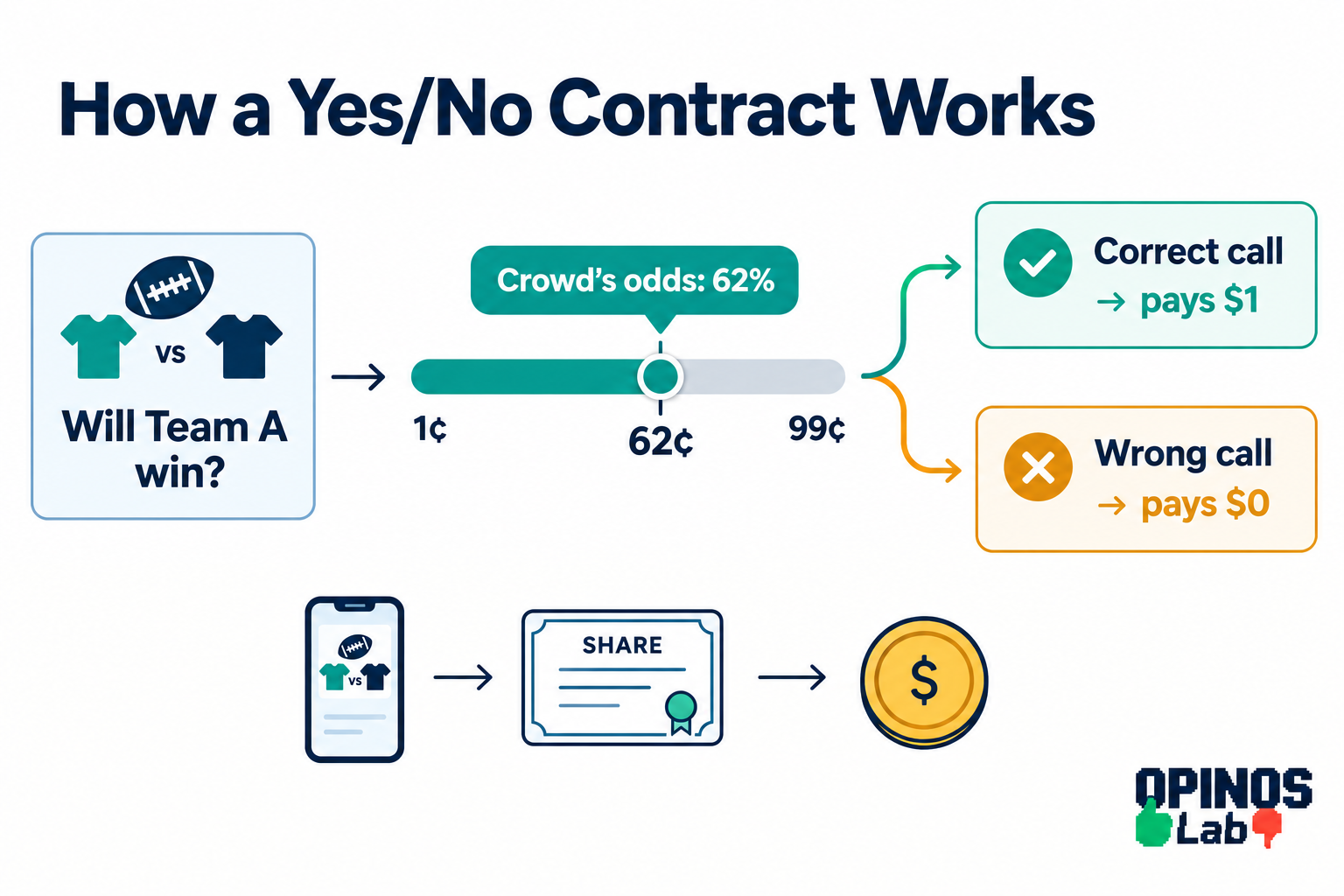
OG is a prediction market app. People trade “Yes” or “No” contracts on real-world events. Each contract trades between 1 cent and 99 cents per share, and a right call pays $1. If you are wrong, it pays nothing.
Crypto.com launched OG on Feb 3, 2026 as a stand-alone app. It runs on CDNA, an exchange registered with the CFTC, the US derivatives regulator. Sports are the hub, but OG lists more than 20 categories, from politics to economic data.
What makes OG feel different? It is part trading app, part social network. Users follow top traders, climb leaderboards and share opinions. Crypto.com also said its prediction business saw 40x weekly growth in the six months before launch.
The money followed. Citadel Securities invested in Crypto.com at a $20B valuation, and OG was spun off at a standalone $5B value.
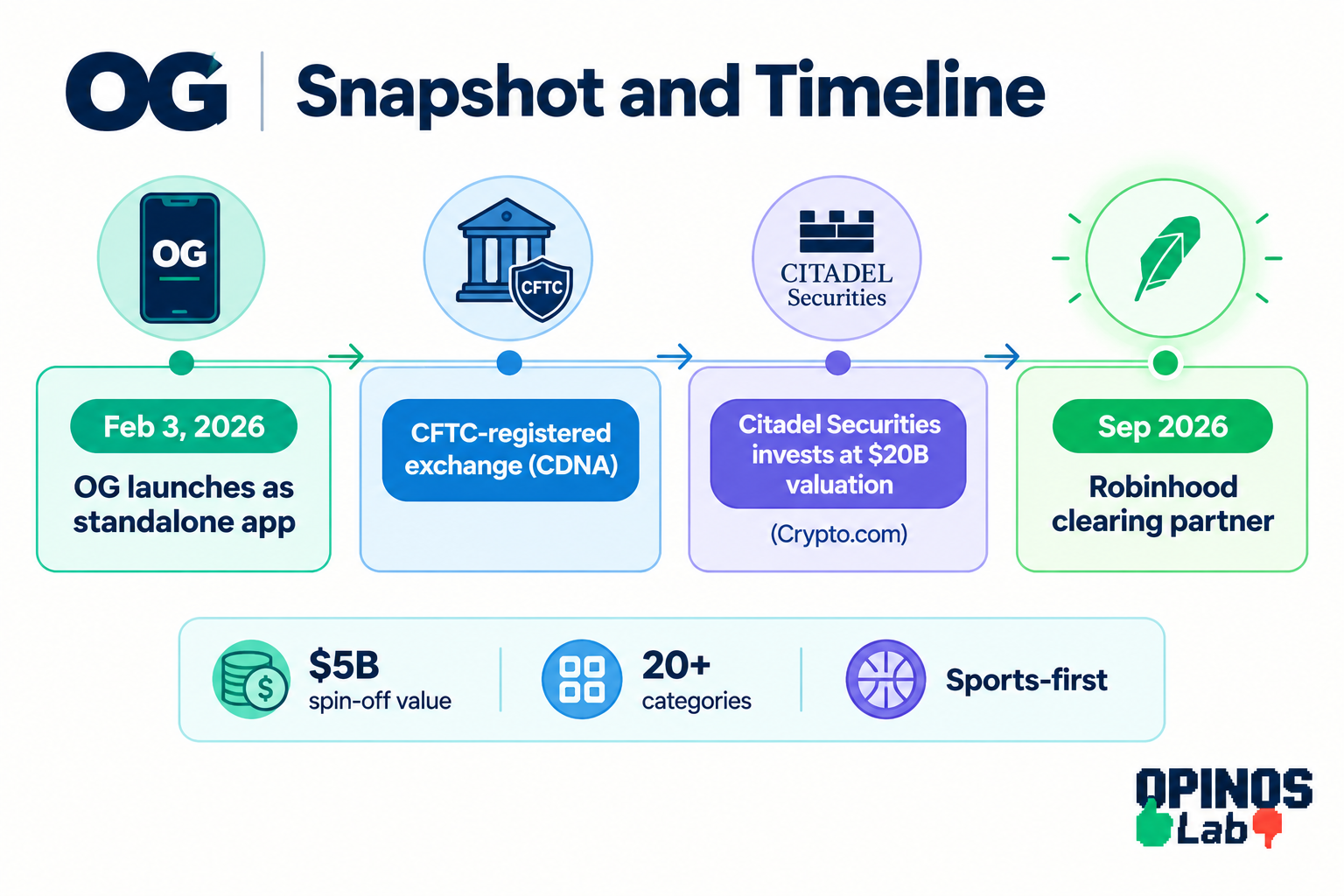
| OG at a glance | Detail |
| Launched | Feb 3, 2026 |
| Parent | Crypto.com (spun off) |
| Regulated through | CFTC-registered exchange (CDNA) |
| Focus | Sports first, 20+ categories |
| Signature features | Leaderboards, trader following, parlays |
| Valuation at spin-off | $5B |
Why Is Now the Right Time to Build?
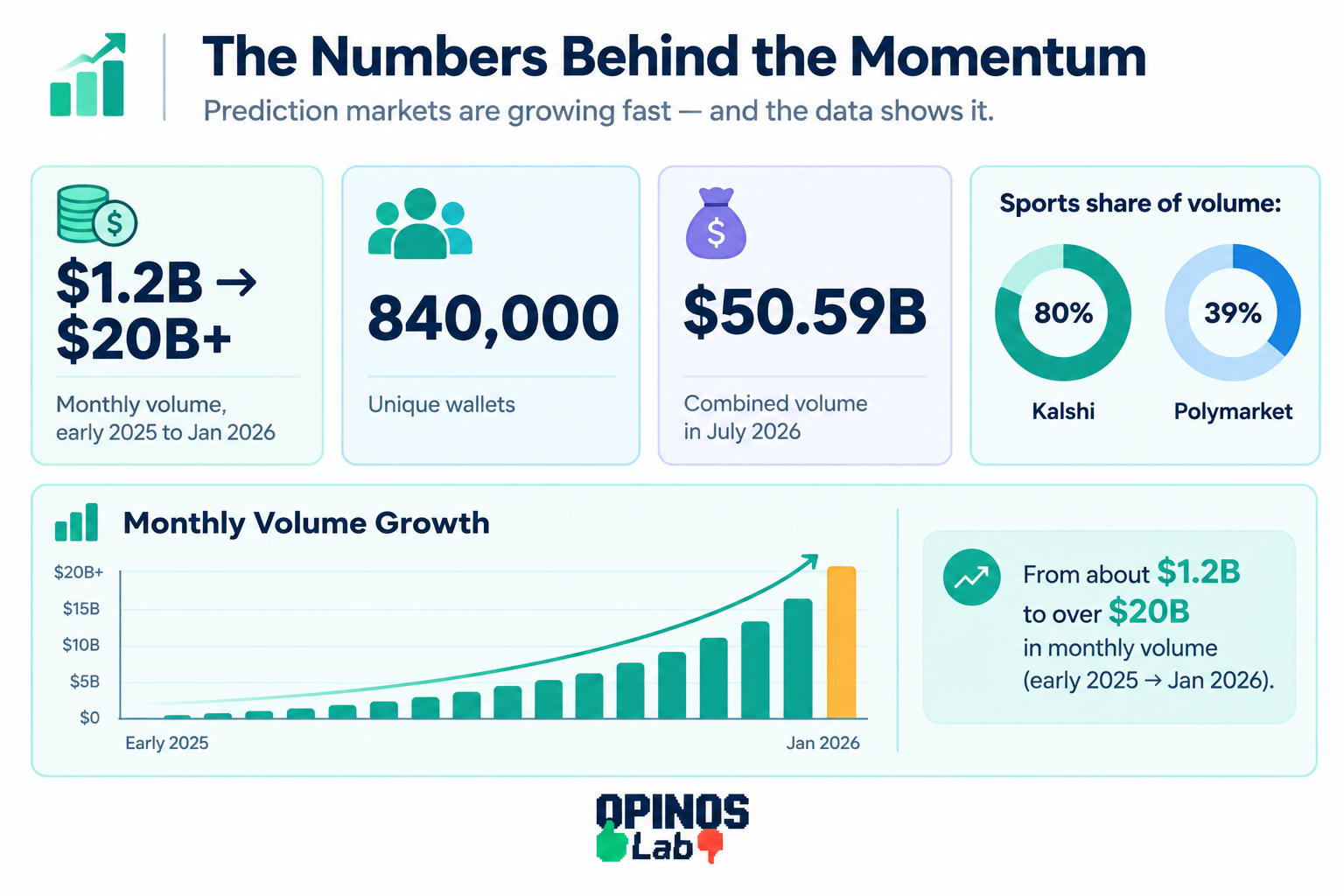
Because prediction markets are growing faster than almost any corner of fintech. Maya looked at the numbers and could not believe them. Here is what she found.
- Monthly volume grew from about $1.2B in early 2025 to over $20B by January 2026, and unique wallets nearly tripled to 840,000.
- Kalshi, Polymarket and Polymarket US together traded $50.59B in July 2026, an all-time high.
- Pew Research found that combined Kalshi and Polymarket volume doubled between May and July.
- Sports made up 80% of Kalshi’s volume and 39% of Polymarket’s since July 2024, which is why OG is sports-first.
- Robinhood has more than 28 million funded customers and now sends event contracts through OG.
The lesson is simple. Users are here. Big brands are here. Distribution deals are open to new platforms with a strong product.
Want to see who else is winning? Our guide to the top 10 prediction market platforms in 2026 shows the leaders.
How Does a Platform Like OG Make Money?
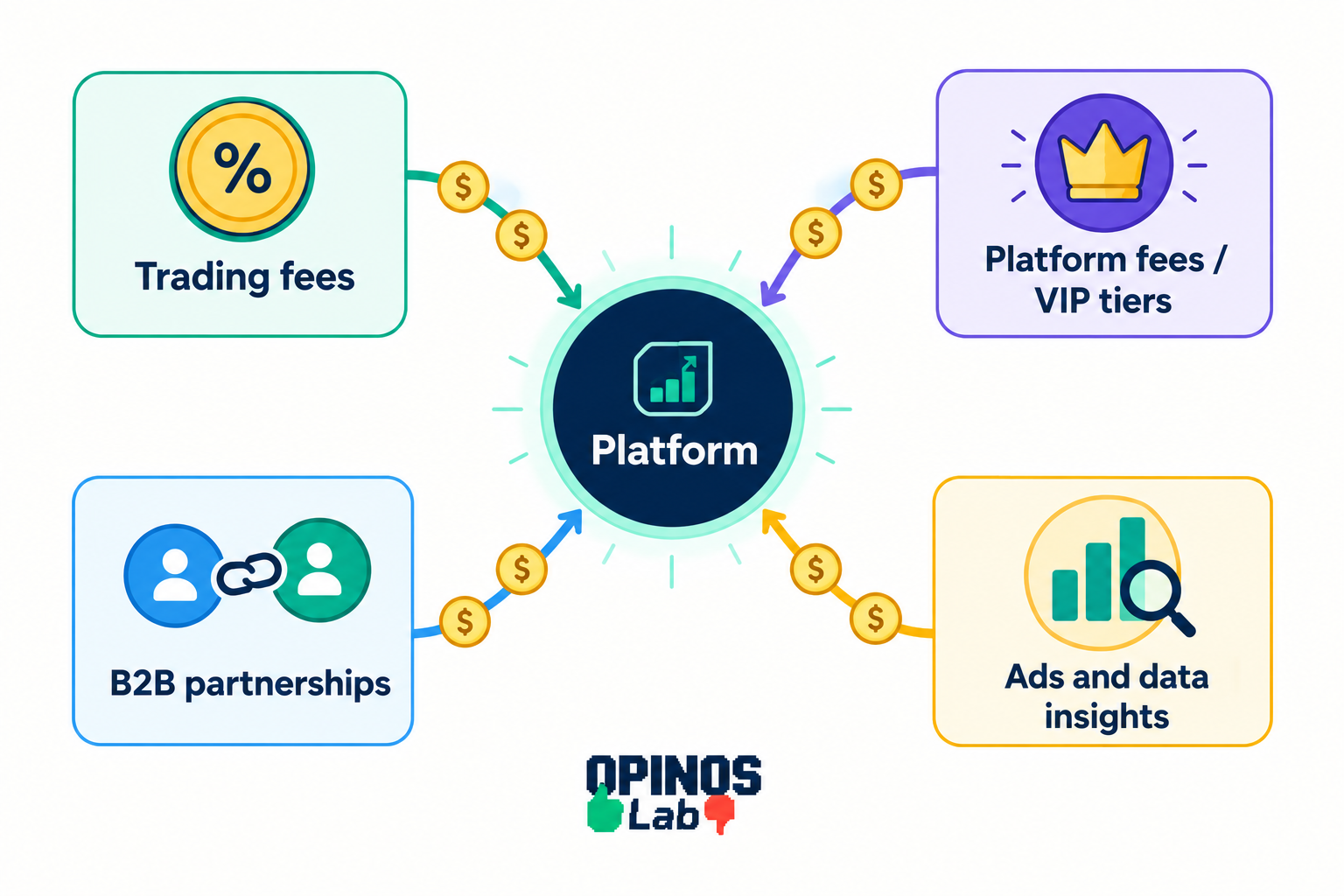
Maya’s next question was the practical one. “How does this pay for itself?” A platform like OG earns money in four main ways.
- Trading fees. The platform takes a small fee on each trade. Fees are tiny, but volume makes them add up.
- Platform fees. Some products add flat fees or paid tiers. OG runs a VIP program for active traders.
- B2B partnerships. Other apps pay to route trades through your exchange. OG calls its Robinhood deal its largest B2B prediction market partnership by volume.
- Ads and data insights. Where the law allows, you can sell ad space or aggregated sentiment data.
Maya did the math on a napkin. Even a small share of a market this size looked worth the effort. For more on revenue models, the FAQ on our home page has a quick summary.
What Features Do You Need?
A prediction market app needs a core set of features to work, plus a few extras to stand out. Maya started with a list.
| Feature | What it does | Why users care |
| KYC and onboarding | Verifies who each user is | Builds trust and meets legal needs |
| Wallet and payments | Handles deposits, withdrawals and balances | Money moves safely and fast |
| Matching engine | Pairs buyers with sellers | Trades fill at fair prices |
| Market creation and resolution | Lists events and settles outcomes | Clear rules, clear payouts |
| Live prices and charts | Shows odds as they move | Users see the crowd’s view |
| Notifications | Alerts on price moves and results | Users come back |
| Admin panel | Controls markets, users and risk | You stay in charge |
Then come the OG-style extras. Leaderboards, trader following, a social feed and parlays turn a trading tool into a community. Our platform includes analytics, secure payments, user ranks, an interactive feed and sentiment analytics.
Maya also asked how to launch fast. Many founders start from a Polymarket clone script to launch faster. It gives you wallets, markets and trading screens on day one. Then you add your own twist.
What Tech Stack and Architecture Will You Need?
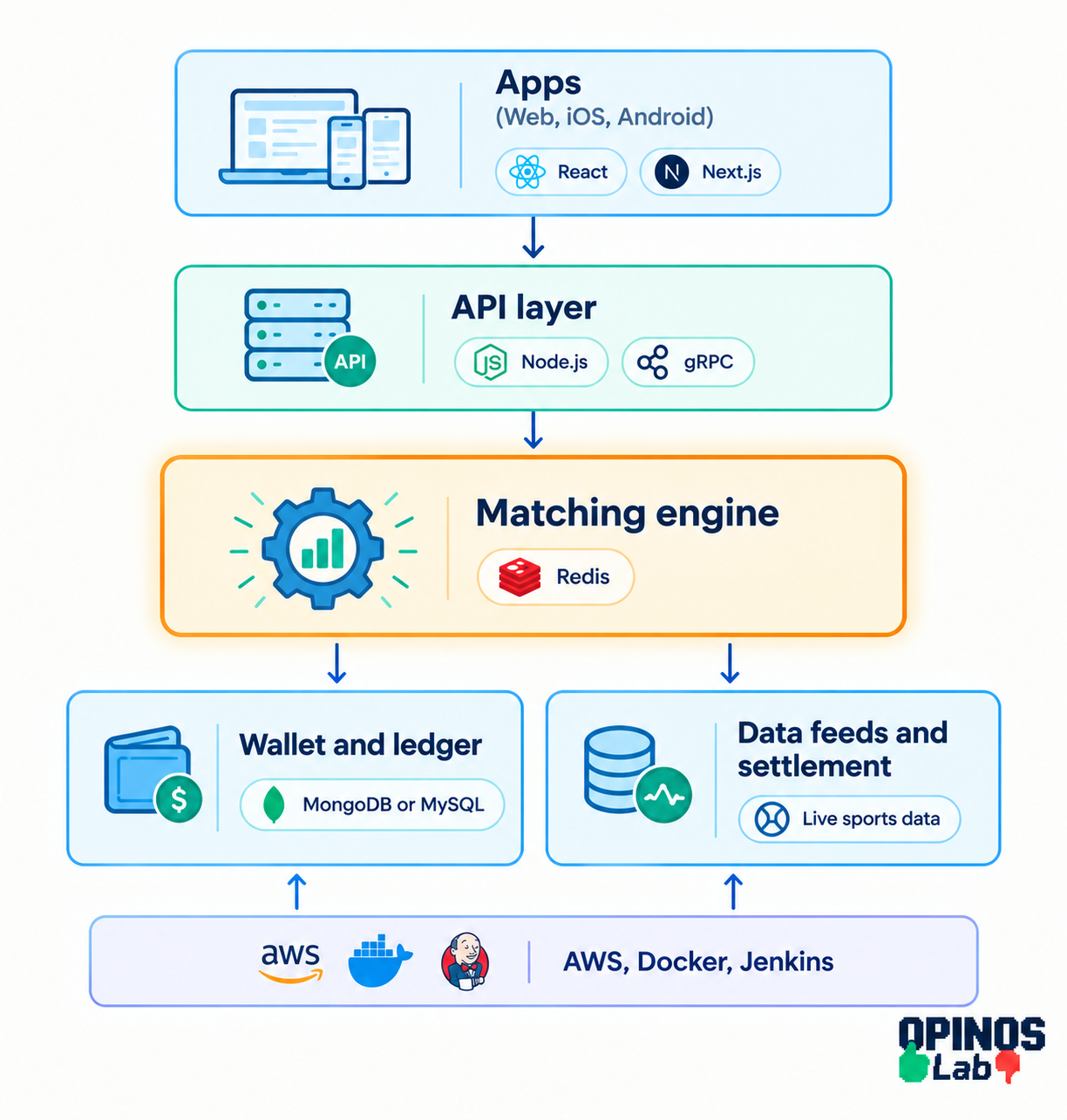
Maya is not an engineer. So her developer explained it in five blocks.
- Apps. Web, iOS and Android screens that users see. React and Next.js power the web side.
- API layer. The messenger between the apps and the system. Node.js and gRPC handle it well.
- Matching engine. The heart of the product. It pairs every buyer with a seller. Redis keeps it fast.
- Wallet and ledger. Tracks every cent in and out. MongoDB or MySQL store the records.
- Data feeds and settlement. Pulls in live scores and results, then pays winners.
Hosting runs on AWS with Docker. Jenkins automates releases. Testing uses JMeter for load, SonarQube for code quality and OWASP checks for security.
Why does this matter? Traffic spikes in the last two minutes of a big game. Thousands of users trade at once. If your system slows down, users leave. Build for the busiest minute, not the average one.
How Do You Stay Legal?
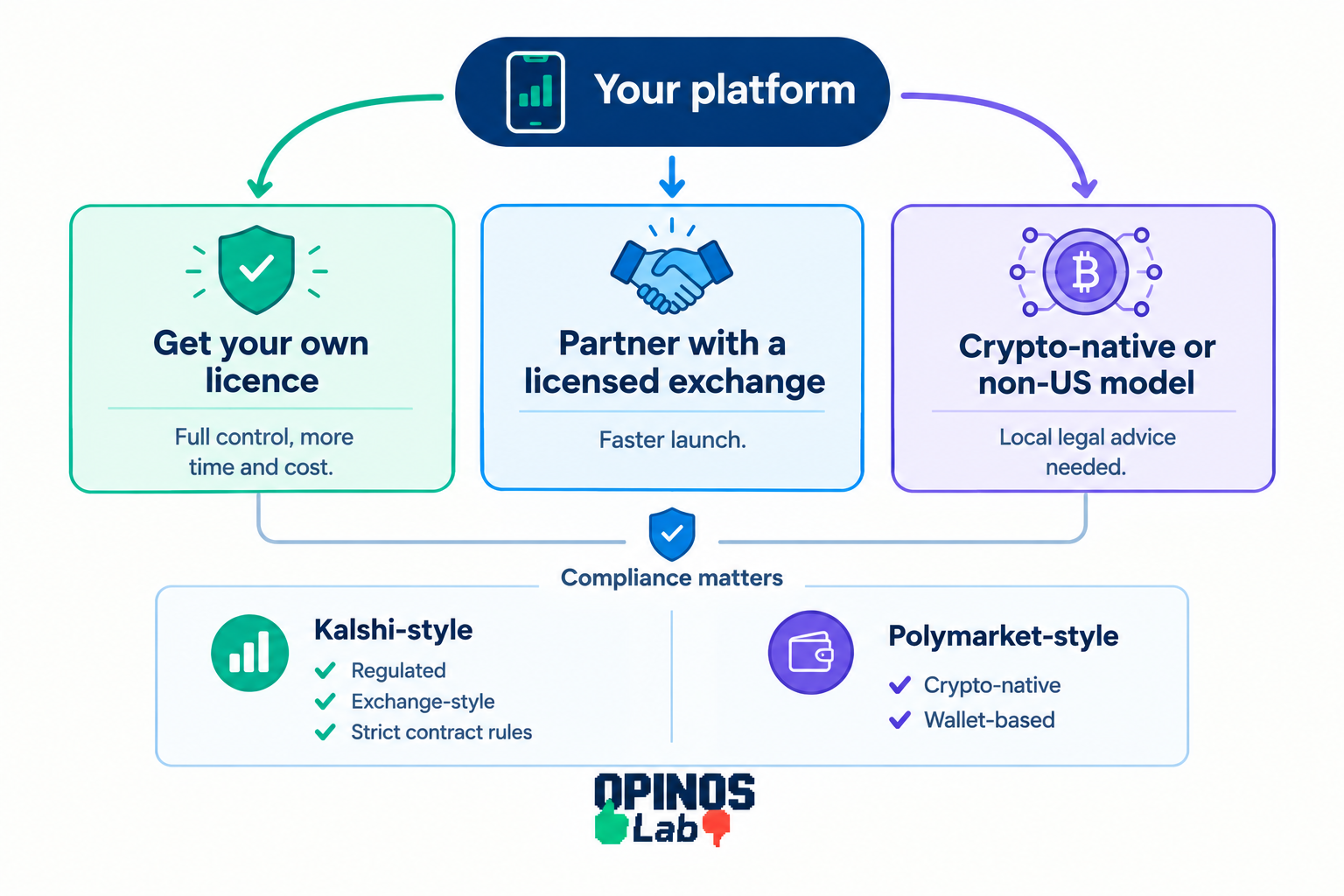
This was the question Maya feared most. It is also the one that matters most.
In the US, a prediction market that offers event contracts to the public must register with the CFTC as a designated contract market. OG sits on CDNA, an exchange that already holds that status.
Maya found three realistic paths.
- Get your own licence. This gives full control. It also takes time, money and legal work.
- Partner with a licensed exchange. Robinhood routes trades through OG. Coinbase launched its offering through a partnership with Kalshi, a regulated operator.
- Build a crypto-native or non-US model. The rules differ by country, so local legal advice is a must.
The ground is still moving. The CFTC has proposed new rules for event contracts. New Jersey has asked the US Supreme Court to decide how far states can regulate sports contracts. Insider trading is under watch too. Kalshi and Polymarket both announced new safeguards in March 2026.
If you want a strict, exchange-style product, a Kalshi clone solution gives you that structure: contract rules, order books and admin controls. The licence, though, stays your job.
Our advice? Talk to a lawyer first. We are a technology partner, not a law firm.
How Do You Build It, Step by Step?
With the rules mapped, Maya was ready to build. Here is the path she followed.
- Pick your model. Will you go regulated and exchange-style, like Kalshi? Or crypto-native, like Polymarket? Maya chose after reading our Polymarket vs Kalshi vs Augur comparison.
- Research and plan. Study users, rivals and gaps. Decide which events you will list first.
- Design the UI and UX. Wireframes and prototypes come first. A clear screen wins trust.
- Build the backend. Servers, databases and APIs. The matching engine goes here.
- Build the frontend and apps. Keep it simple, fast and easy to use on a phone.
- Test and secure. Check function, speed, usability and security. Fix bugs before users find them.
- Launch and support. Ship to the app stores, watch the data and update often.
This is the same process we follow at Opinios Lab for every client. You can also see a partner-exchange approach in our guide to building a platform like Coinbase as an example.
How Much Does It Cost, and How Long Does It Take?
A full prediction market platform costs about $50,000 to $200,000 or more, based on our FAQ. The final price depends on your features, tech stack, security needs and post-launch support.
Clone-based builds cost less. A Probo clone, for example, usually runs $10,000 to $50,000.
Time works the same way. A simple version takes about 4 to 6 weeks. A complex one, with blockchain or multi-language support, takes 8 to 12 weeks.
| Cost driver | Why it changes the price |
| Features | More markets, social tools and parlays mean more build time |
| Compliance | Licensing and KYC checks add legal and technical work |
| Integrations | Payment gateways and live sports data feeds add cost |
| Security | Audits and load testing protect users and money |
| Support | Updates and monitoring continue after launch |
Maya sent us her list and got a clear quote within days. You can do the same. Just share your project requirements and we will map the scope, cost and timeline with you.
Why Choose Opinios Lab as Your Prediction Market Platform Development Company?
Maya met several teams. Here is what made her pick a specialist.
- Customisation. We shape the platform around your business goals, not a one-size template.
- Scalability. The platform handles large volumes of data and trades without slowing down.
- Range. We build Polymarket, Kalshi, Augur, Probo, PredictIt and other clone-style platforms, so you can start from a proven base.
- Support. Our team stays with you from analysis to launch and through ongoing updates.
Want to see how we approach a different model? Our guide to building a platform like Onyx Odds shows a sports-first approach.
Frequently Asked Questions
What is a prediction market platform like OG?
It is an app where users trade Yes or No contracts on real-world events. Prices show the crowd’s view of the odds. A winning contract pays $1. A losing one pays nothing.
How much does it cost to build one?
A full platform costs about $50,000 to $200,000 or more. Clone-based builds, such as a Probo clone, usually run $10,000 to $50,000. Features, security and support change the final price.
How long does development take?
A simple version takes about 4 to 6 weeks. A complex version, with blockchain or multi-language support, takes 8 to 12 weeks.
Do I need a licence to launch?
In the US, a platform offering event contracts to the public must register with the CFTC, or work with a partner that has. Rules differ by country. Get legal advice before you launch.
What is the difference between a Polymarket clone script and a Kalshi clone solution?
In short, a Polymarket clone script follows the crypto-native, wallet-based model, while a Kalshi clone solution follows the regulated, exchange-style model with stricter contract rules.
Final Thoughts: Maya’s Next Move
A few weeks later, Maya had a plan. She had a model, a legal path and a build team. She was no longer asking “Could I build this?” She was asking “When do we launch?”
Three things stand out from her journey. The market is real and growing. Your choice of model shapes everything. And compliance comes first, not last.
If you are ready to build, the right prediction market platform development company can save you months. Your next step is to talk to Opinios Lab and turn your idea into a working platform.

Start Creating Your Own Prediction Platform


Disclaimer
As per the Online Gaming Bill, 2025 and applicable Indian laws, we strictly do not develop, provide, or promote any Real Money Games (RMG), Real Money Features, RMG Development Services, or Game with RMG Features. While our website may mention terms like “Real Money Game” or “RMG Features” for general informational and educational purpose.