It is a platform where users trade contracts on real event outcomes. Prices reflect the crowd’s odds. Users trade against each other, not a house. ProphetX focuses on sports and runs under CFTC regulation.



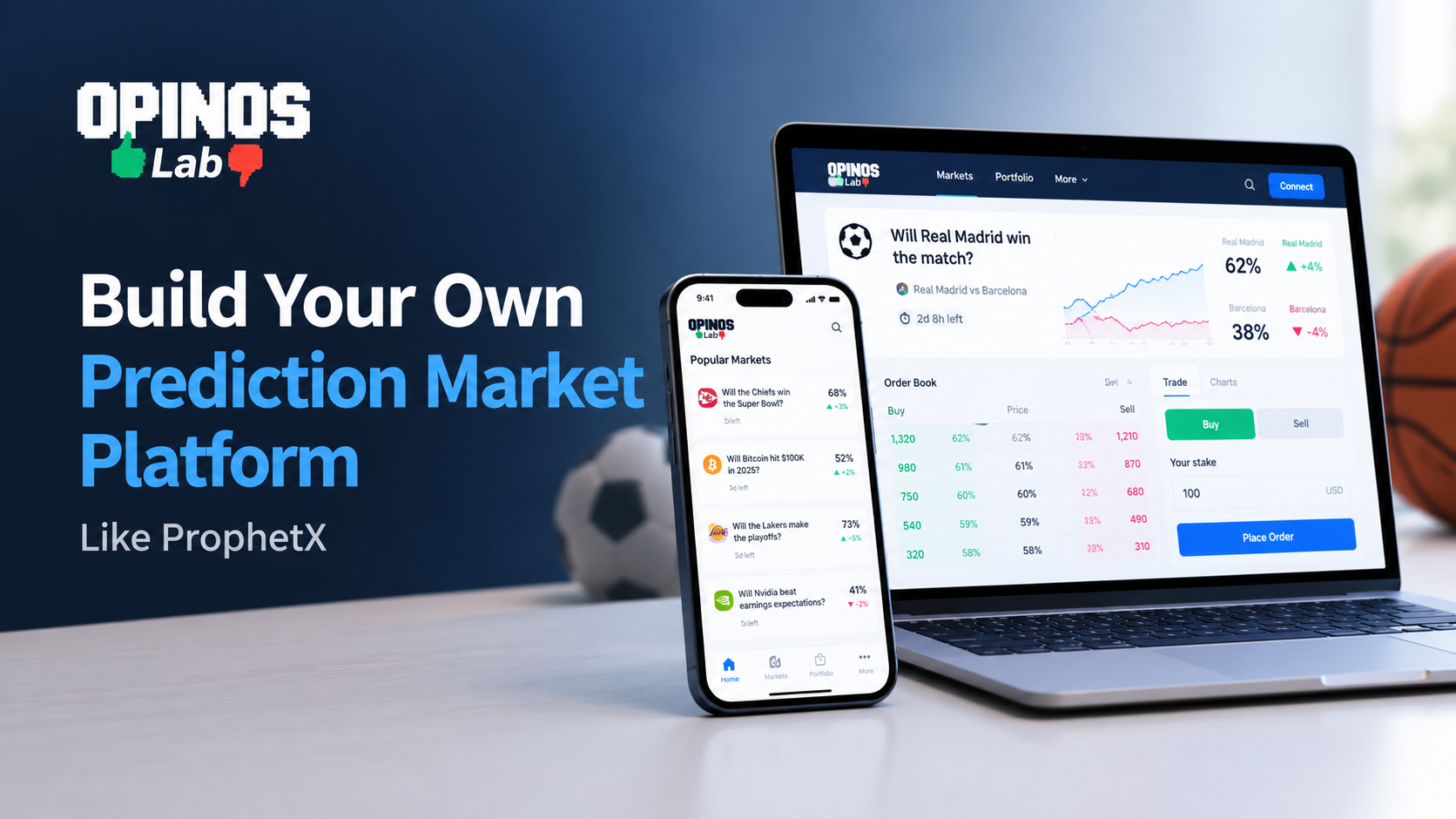
30th September 2026
Imagine you open a sports app. You do not bet against a bookmaker. You trade against other fans, and you set your own price. That is the idea behind ProphetX, and you can develop your own prediction market platform like ProphetX faster than you think. Prediction markets are one of the fastest growing corners of fintech right now. Monthly trading volume already runs into the billions. So the real question is simple. Should you build this, and how soon can you launch? The short answer: yes. With a prediction market platform development company like Opinios Labs, you can go live in about 60 days.
Let us walk through it together.
What Is ProphetX and Why Everyone Is Talking About It
Quick answer: ProphetX is a sports native, CFTC regulated prediction market. Users trade event contracts against each other, not against a house.
Definition: a prediction market is a platform where people trade contracts on the outcome of real events. The price reflects the crowd’s view of the odds.
ProphetX runs as a peer to peer sports betting exchange. Prices move with market demand and implied probability. There are no fixed house lines. It uses an order book and back and lay betting. You can set your own odds on a market. The platform earns a small commission on net winnings. It does not bake in a hidden margin.
The regulatory story matters here. As Sportico reported, ProphetX won CFTC approval in June 2026. That made it America’s first federally regulated sports native exchange. It then launched nationwide on June 18, 2026, during the FIFA World Cup. That timing gave it a huge audience from day one. The app also earned strong early reviews, carrying a 4.9 star rating on the app store at review time.
How Prediction Markets Exploded Into a Multi Billion Dollar Market
Quick answer: Prediction market volume jumped from under 5 billion dollars a month in mid 2025 to nearly 24 billion dollars a month by April 2026. Sports led the surge.
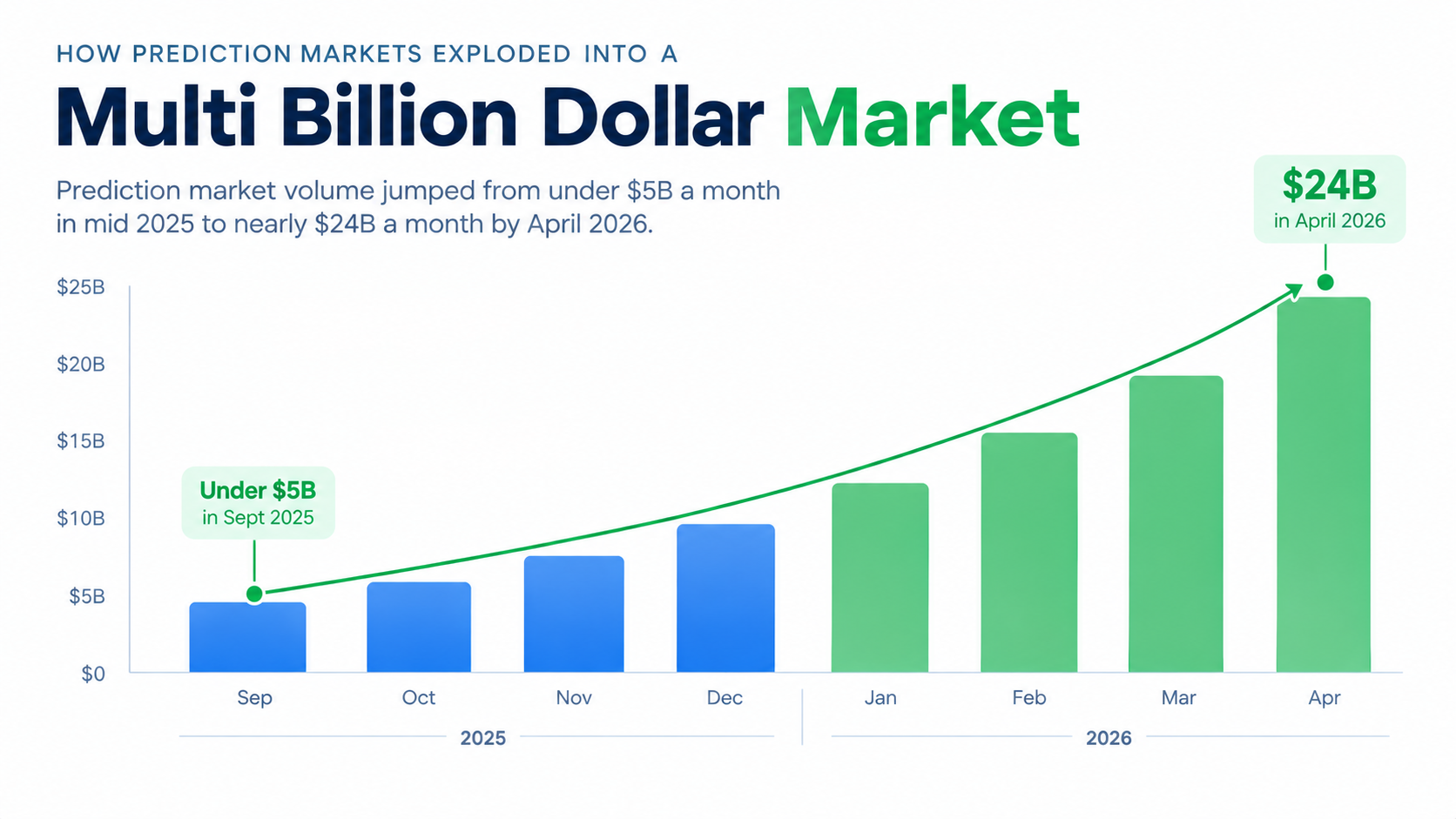
The category went mainstream fast. Monthly volume reached about 24 billion dollars in April 2026. That was up from under 5 billion dollars in September 2025. Global volume told the same story. It hit roughly 64 billion dollars in 2025, about a four times jump from 2024 (source: FalconX via AcadeResearch).
Sports is the biggest engine. Per Pew Research Center data, sports made up about 80 percent of Kalshi volume since July 2024. It made up about 39 percent of Polymarket volume in the same period. During the World Cup in June and July 2026, sports trading topped 58 billion dollars on Kalshi. It neared 22 billion dollars on Polymarket.
Two giants, Kalshi and Polymarket, hold most of the market. That leaves clear room for focused challengers like ProphetX. Analysts stay bullish too. Some industry forecasts project the market could reach between 240 billion and over 1 trillion dollars by the end of 2026.
This is the “why now” for founders. The wave is still early, and sports is wide open.
Should You Build Your Own Platform or Partner With an Exchange
Quick answer: Building your own platform gives you full control of the brand, the data, and the revenue. Partnering ties you to someone else’s rules and margins.
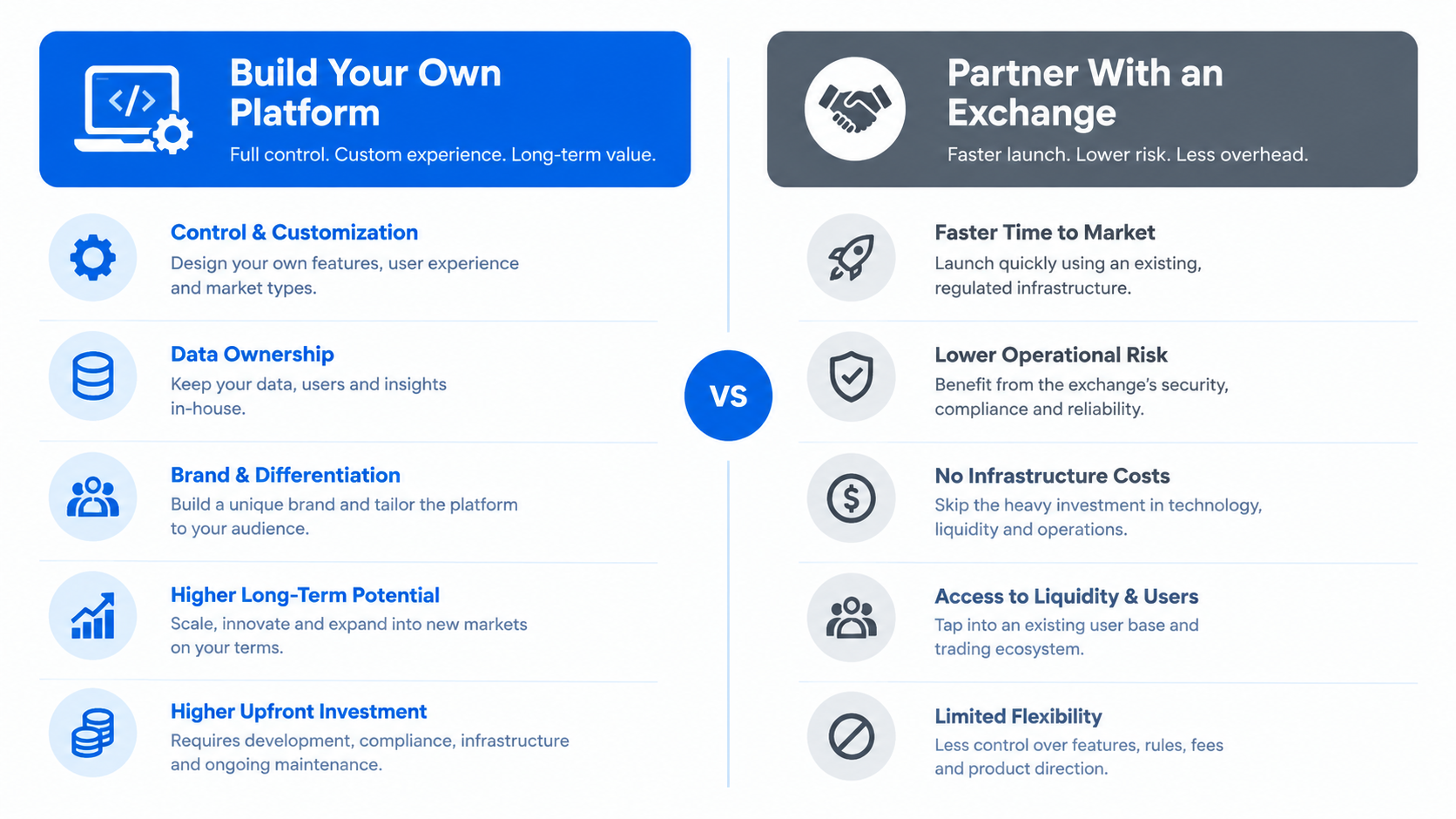
Here is the trade off at a glance.
| Factor | Build your own platform | Partner with an existing exchange |
| Brand control | Full | Limited |
| Revenue share | You keep the fees | Split with the partner |
| Data ownership | Yours | Shared or restricted |
| Time to launch | Fast with clone scripts | Fast but dependent |
| Customisation | Unlimited | Capped by their roadmap |
| Long term value | Builds an asset you own | Rents someone else’s rails |
Both routes can be quick. Only one builds an asset you own. When you build, the fees, the users, and the data stay with you. When you partner, you rent someone else’s rails. For most founders with real ambition, the build route wins. If you want a deeper walkthrough of the build path,
see this guide on how to build a platform like Coinbase.
Core Features of a ProphetX Style Prediction Market Platform
Quick answer: A ProphetX style platform needs an order book, back and lay betting, real time pricing, secure wallets, KYC, and an admin panel.
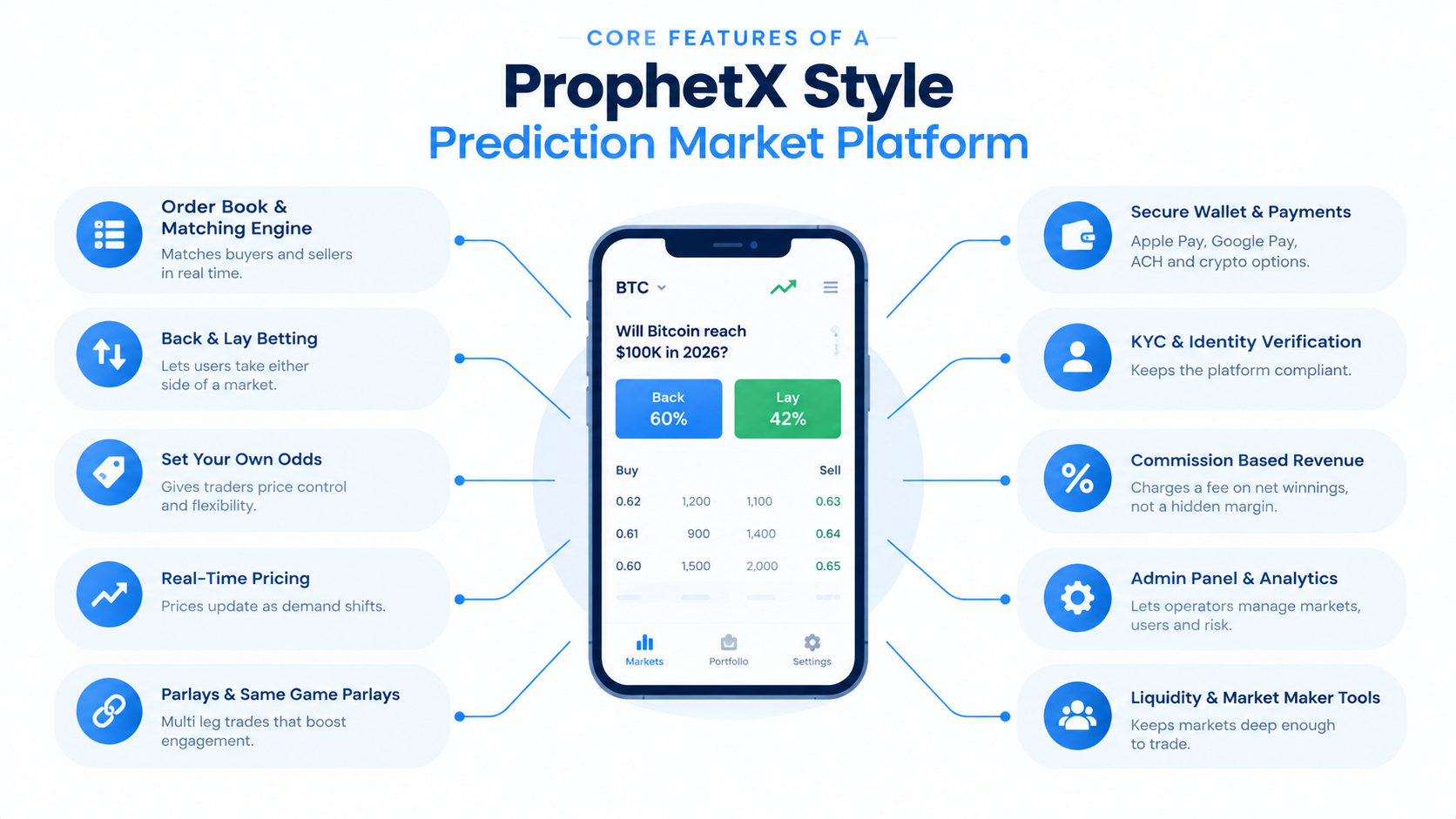
Think of these as the building blocks. Each one earns its place.
| Feature | Why it matters |
| Order book and matching engine | Matches buyers and sellers in real time. This is the heart of the exchange. |
| Back and lay betting | Lets users take either side of a market. |
| Set your own odds | Gives traders the price control ProphetX is known for. |
| Real time pricing and implied probability | Prices update as demand shifts. |
| Parlay and same game parlay support | Multi leg trades that boost engagement. |
| Secure wallet and payments | Apple Pay, Google Pay, ACH, and crypto options. |
| KYC and identity verification | Keeps the platform compliant. |
| Commission based revenue engine | Charges a fee on net winnings, not a hidden margin. |
| Admin dashboard and analytics | Lets operators manage markets, users, and risk. |
| Liquidity and market maker tools | Keeps markets deep enough to trade. |
The order types matter too. Users place limit orders to set a price. They place market orders to trade at the best price now. They can cancel or edit resting orders. This mix is what makes a real exchange feel alive. It is the same core you get in a Polymarket clone build from Opinios Labs.
Add AI to Stand Out From ProphetX
Quick answer: AI now powers market making, pricing, fraud checks, and outcome resolution. A new platform can launch smarter than the incumbents.
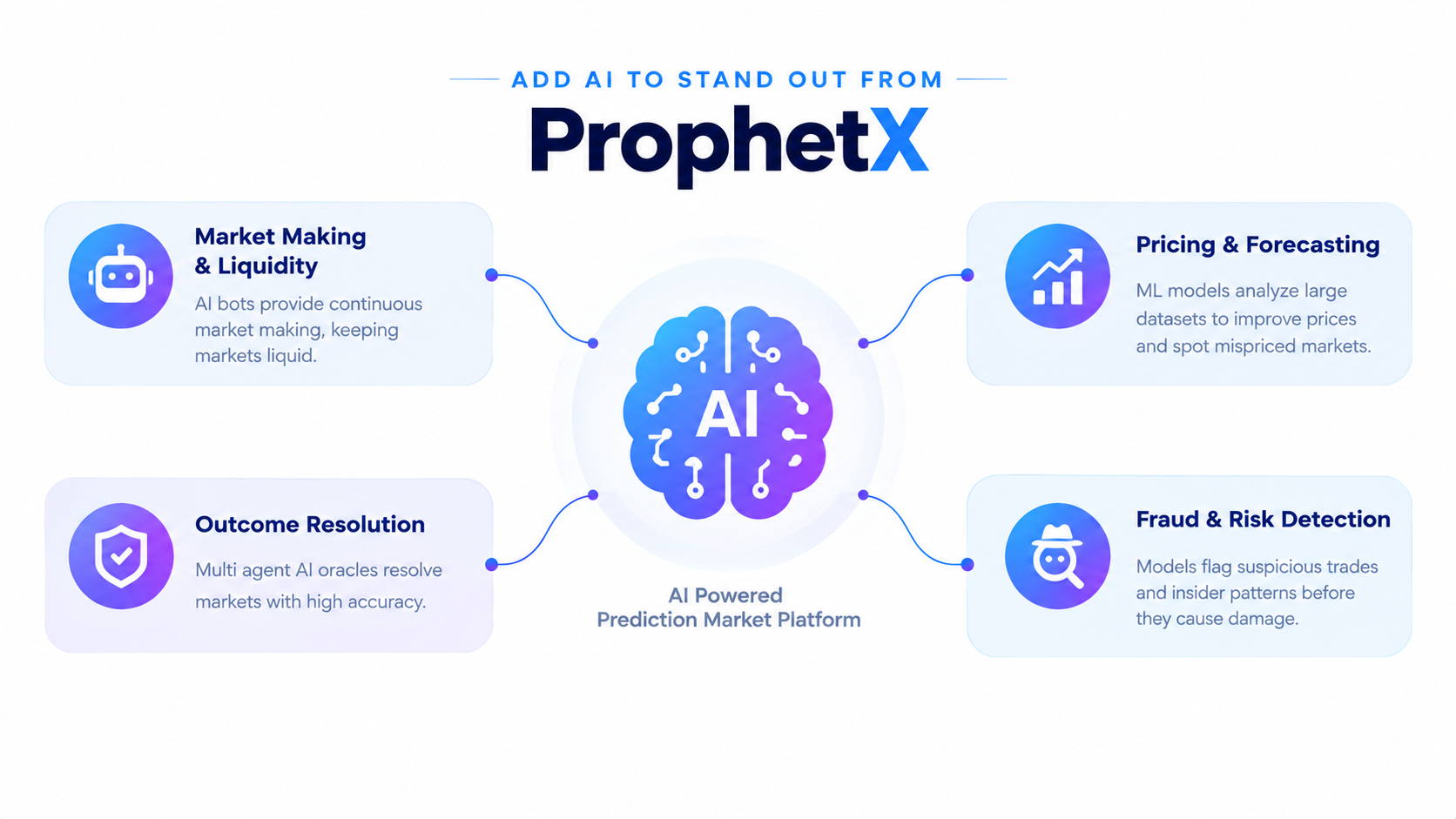
Here is where you can leapfrog older platforms. AI gives you an edge on day one.
AI market making and liquidity. AI bots provide continuous market making. The bot never sleeps, so your markets always have a price. That keeps thin markets liquid and tradeable. Chainlink explains how AI agents can run this role around the clock.
AI pricing and forecasting. Machine learning models chew through large data sets. They sharpen implied probabilities and spot mispriced markets fast.
AI powered outcome resolution. Multi agent AI oracle systems can resolve markets with high accuracy. Recent research reached about 83 percent accuracy on prediction market questions. This is the same oracle logic behind an Augur markets clone.
AI fraud and risk detection. Models flag suspicious trades and insider patterns before they hurt you.
AI sentiment analytics. The system reads news and social signals. It feeds that mood back into the markets.
Opinios Labs already lists AI driven predictive and sentiment analytics as a platform feature. So this is not a someday promise. It ships with the build.
The Technology Stack Behind a Prediction Market Platform
Quick answer: A prediction market platform runs on a Node.js backend, a React or Next.js frontend, MongoDB or MySQL, Redis for speed, and cloud hosting on AWS. The matching engine sits at the center.
You do not need to memorise this. But the details decide whether your platform feels fast or slow. Let us open the hood.
Here is the stack by layer.
| Layer | Common choices |
| Frontend | React, Next.js, Swift (iOS), Android (Kotlin) |
| Backend | Node.js, gRPC |
| Database | MongoDB, MySQL, Redis |
| Payments and data | Multiple payment gateways, sports data feeds |
| Security and testing | OWASP practices, SonarQube, JMeter, Firebase |
| Deployment | AWS, Docker, Jenkins |
Now here is what actually happens under the surface.
The matching engine is the core
The matching engine is the brain of the exchange. It pairs buy orders with sell orders. It follows price time priority. The best price trades first. Among equal prices, the earliest order trades first. This keeps the market fair and predictable.
The engine holds the order book in memory. Memory is fast, and speed is everything here. A common choice is Redis with sorted sets. Each price level maps to a score. The engine reads the best bid and best ask in microseconds. When two orders cross, the engine fills them and updates balances.
The engine must also handle race conditions. Two users may hit the same order at once. So the code uses locks or atomic operations. That way one order never fills twice. This is the part you cannot cut corners on.
The real time layer keeps prices live
Prediction markets live and die on real time updates. Users need to see prices move as they happen. So the platform uses WebSockets, not slow page refreshes. The server pushes updates the moment the book changes.
Behind that, a message system fans out updates. Redis pub or sub works well for this. Larger builds add Kafka or RabbitMQ. These queues move events between services without blocking. Your order service talks to your notification service through the queue. Nothing waits on anything else.
Databases carry the load in layers
You do not use one database for everything. You split the work.
- Redis holds the live order book and session data. It is in memory and very fast.
- MongoDB or MySQL stores users, trades, wallets, and market history. This is the durable record.
- A cache layer sits in front of heavy reads. It cuts database load during big events.
MongoDB fits flexible market data well. MySQL fits strict financial records well. Many platforms use both. You match the tool to the job.
Payments, wallets, and data feeds
Money flow needs care. The wallet service tracks every balance. It must be idempotent. That means a retried payment never charges twice. You log every transaction with a clear audit trail.
Payment gateways handle deposits and payouts. Think cards, ACH, Apple Pay, Google Pay, and crypto rails. Each integration needs webhooks and reconciliation. Sports data feeds bring in live scores and results. These feeds settle markets, so accuracy is critical. A bad feed means a wrong payout.
Security and testing you cannot skip
This platform holds money, so security comes first. Follow OWASP practices across the code. Encrypt data in transit and at rest. Add rate limiting to stop abuse. Use strong authentication and role based access.
Test hard before launch. SonarQube scans the code for flaws. JMeter runs load tests for peak traffic. Firebase and other tools track crashes in the wild. You test the matching engine under heavy load. Big sports events create huge spikes.
Hosting, scaling, and DevOps
The platform runs on the cloud, usually AWS. You package services with Docker. You automate builds and releases with Jenkins. This keeps deploys fast and safe.
Scaling is the real test. Traffic is calm most days. Then a final match arrives and it explodes. So you design for horizontal scaling. Load balancers spread traffic across many servers. Stateless services let you add capacity in minutes. The matching engine may run as its own service, tuned for speed. This split is why a well built platform stays up when it matters most.
This mirrors the stack and the architecture Opinios Labs already uses. That means fewer surprises and a smoother build.
How Much Does It Cost to Develop a Platform Like ProphetX
Quick answer: A custom build can cost roughly 50,000 to 200,000 dollars or more. A ready made clone script cuts both the cost and the time.
Several things drive the price. Features drive it. So do the tech stack, the complexity, the security work, and ongoing support. Add more, pay more.
A clone script route lowers that cost sharply. You start from a proven base, not a blank page. A leaner option like a Probo clone build can trim it further. Here is the simple trade off.
| Build route | Rough cost | Rough timeline |
| From scratch, fully custom | 50,000 to 200,000 dollars and up | 4 to 8 months |
| Ready made clone script (Opinios Labs) | Lower, quote based | About 60 days |
From scratch means more money and more months. A clone script means faster and cheaper. For most founders, speed to market is the smarter bet.
Note: these figures are informational only. This is not a promise of returns, and it is not a real money gambling promise.
How Long Does It Take to Launch (The 60 Day Path)
Quick answer: With ready made clone scripts, Opinios Labs can launch a ProphetX style prediction market platform in about 60 days.
Speed is the whole advantage. Here is the path, phase by phase.
| Phase | What happens | Rough time |
| Discovery and planning | Requirements, market scope, compliance check | Week 1 to 2 |
| Design and customisation | UI, branding, feature selection on the clone base | Week 2 to 4 |
| Development and integration | Payments, data feeds, wallet, AI modules | Week 4 to 7 |
| Testing and QA | Security, load, and usability testing | Week 7 to 8 |
| Launch and support | Deploy, monitor, and maintain | Week 8 plus |
Sixty days is realistic because you skip the slow part. The core engine already exists. You customise, test, and go live.
Compliance and Regulation You Cannot Ignore
Quick answer: ProphetX operates under CFTC regulation. Any similar platform must plan for licensing, KYC, and regional rules from day one.
Definition: a sports betting exchange lets users trade bets with each other. The platform takes a commission, not a house margin.
CFTC regulation is what made the nationwide US model work for ProphetX. But the rules still shift. They differ by state and by country. Legal disputes over sports event contracts continue. So you cannot treat compliance as an afterthought.
Build it in from the start. That means strong KYC, responsible play tools, and geo restrictions where needed. The same compliant architecture underpins a Kalshi clone build, where regulated event contracts are the whole point. Opinios Labs builds this in as part of the platform, not as a patch later.
Compliance disclaimer: Opinios Labs does not build real money gambling products in India, in line with the Online Gaming Bill, 2025. The focus stays on regulated, compliant, event contract style platforms.
Why Choose Opinios Labs to Build Your Prediction Market Platform
Quick answer: Opinios Labs is a specialist prediction market platform development company that launches ready made, customisable platforms in about 60 days.
Here is why founders pick them.
- Specialist focus. They build only prediction and opinion trading platforms.
- Ready made clone scripts. Polymarket, Kalshi, Probo, Augur, Manifold, PredictIt, and Metaculus.
- Fast launch. About 60 days from kickoff.
- Lower cost. Cheaper than building from scratch.
- Full service. From research to post launch support and maintenance.
They also bring real depth in the mechanics. Order books, matching engines, LMSR pricing, AI oracles, and a proven tech stack. That is experience you can lean on, backed by the wider Yudiz Solutions team.
Ready to launch your prediction market platform? Talk to Opinios Labs.
Conclusion
Prediction markets are booming, and sports leads the way. The volume numbers prove it. That is a rare window for founders who move now. You have a choice to make. Build your own asset, or rent someone else’s rails. Owning the brand, the data, and the fees is the stronger long term play.
Opinios Labs makes that build simple. Ready made clone scripts, lower cost, about 60 days to launch, and AI ready from day one. Want to read more first? Browse our prediction market blogs for deeper guides.
Talk to Opinios Labs and launch your platform.
Frequently Asked Questions
What is a prediction market platform like ProphetX?
How much does it cost to build a prediction market platform?
A custom build runs roughly 50,000 to 200,000 dollars or more. Cost depends on features, security, and complexity. A ready made clone script from Opinios Labs costs less and is quote based.
How long does it take to develop a ProphetX style platform?
With ready made clone scripts, Opinios Labs can launch in about 60 days. A full custom build usually takes four to eight months. The clone route is faster because the core engine already exists.
Is a prediction market platform legal?
It depends on your region. ProphetX operates under CFTC regulation in the US. Rules differ by state and country. You must plan for licensing, KYC, and geo restrictions from the start.
Can I add AI features to my prediction market platform?
Yes. AI can power market making, pricing, fraud detection, and outcome resolution. Opinios Labs already offers AI driven predictive and sentiment analytics as part of the build.
What is a ProphetX clone script?
It is a ready made software base that mirrors ProphetX core features. You customise the brand, features, and design on top. It cuts cost and speeds up launch.
Can Opinios Labs launch my platform in 60 days?
Yes. Using ready made clone scripts, Opinios Labs targets a launch in about 60 days. The timeline covers discovery, design, development, testing, and go live.

Start Creating Your Own Prediction Platform


Disclaimer
As per the Online Gaming Bill, 2025 and applicable Indian laws, we strictly do not develop, provide, or promote any Real Money Games (RMG), Real Money Features, RMG Development Services, or Game with RMG Features. While our website may mention terms like “Real Money Game” or “RMG Features” for general informational and educational purpose.