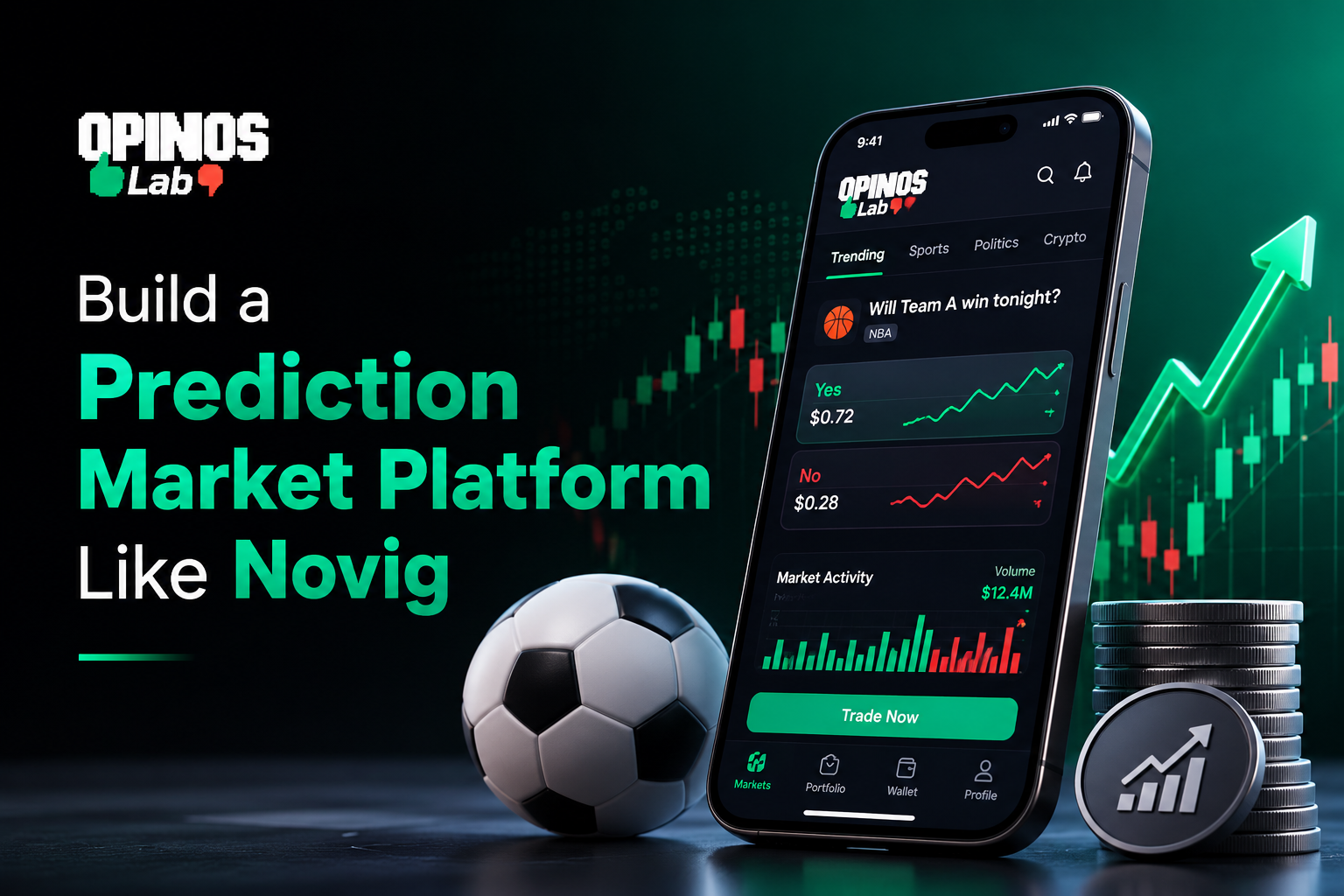
A prediction market platform like Novig allows users to trade contracts based on the outcome of real-world events, such as sports games. Instead of a bookmaker setting fixed odds, prices are influenced by users buying and selling contracts. As new information becomes available, market prices can change in real time.



11th August 2026
Imagine opening a sports trading app where you are not betting against a bookmaker. You are trading against other people, and the price moves in real time as new information comes in. That is the idea behind platforms like Novig, and it is quickly becoming one of the more interesting opportunities in fintech. Combined monthly trading volume on major prediction market platforms climbed from under $5 billion in September 2025 to nearly $24 billion by April 2026. For an investor, that kind of growth is hard to ignore. But building a platform like this is closer to building a small stock exchange than a betting site, and the difference matters from the very first line of code.
This guide walks through what actually goes into building a prediction market platform, from the foundational ideas and terminology, through architecture and trading infrastructure, to the challenges most new platforms run into and where the industry is headed next.
Chapter 1: Foundational Concepts of Prediction Market Platforms
What Is a Prediction Market Platform Like Novig?
A prediction market lets people trade contracts tied to real-world questions, such as “Will Team A win tonight?” Instead of a bookmaker setting the odds, the price is set by the crowd through buying and selling. As new information arrives, prices shift, turning the market into a live snapshot of what people believe will happen. The U.S. Commodity Futures Trading Commission, or CFTC, refers to these products as “event contracts” and regulates them under the Commodity Exchange Act.
Why This Business Model Is Growing So Fast
Sports-related contracts are becoming the biggest driver of the industry. One 2026 industry snapshot projected that annual trading on sports event contracts could reach $100 billion, calling sports the sector’s main growth engine. Separately, blockchain analytics firm TRM Labs found that unique wallets trading on these platforms more than tripled to roughly 840,000 in the six months leading up to February 2026. That growth is not limited to crypto-native users either. It is increasingly coming from everyday sports fans who want a more active way to follow the games they already watch. Growth like this also draws regulatory attention fast, which is exactly why compliance has to be part of the plan from day one, not something added later.
Key Terms You Should Know
A few terms come up constantly in this space, so it helps to define them early. An order book is a live list of buy and sell orders that a matching engine pairs together. Automated liquidity, sometimes called an automated market maker, uses a pricing formula instead of waiting for a matching order. Settlement is the process of deciding a market’s final outcome and paying out winners. Liquidity simply means having enough active buyers and sellers so that trades happen at fair prices.
Chapter 2: Getting Started With Development
Choose Your Niche Before You Choose Your Tech Stack
It is tempting to launch markets covering sports, politics, crypto, and entertainment all at once. That usually backfires, because liquidity gets thin everywhere instead of strong somewhere. A sports-only launch focused on one or two leagues gives the platform a steady stream of new questions every week, which keeps users coming back and gives the trading engine a realistic flow of activity to learn from. Expansion into new categories should come after the first niche proves itself, not before.
The Core Architecture Behind the Interface
The trading screen is the easy part. Behind it, a prediction market platform needs several systems working together: user accounts and identity checks, a wallet system that tracks available and committed balances, a market engine that defines each question and its rules, a matching engine that pairs trades, a settlement engine that determines outcomes, a risk and compliance layer, and an admin dashboard. Each system depends on the others, so the architecture should be mapped out before any screen gets designed. If the wallet is sloppy, users cannot trust their balances. If the settlement rules are unclear, disputes pile up fast, and support teams end up guessing instead of answering with confidence.
Essential Features Your Platform Needs
A serious first version needs a real-time market dashboard, clear buy and sell functionality, portfolio and transaction history, wallet management, notifications, and an admin panel for managing markets and users. It should also show enough detail on every market page that a user never has to guess how a trade will actually resolve. Advanced order types, social features, and multiple mobile apps can wait. The goal of the first release is not to match every feature of an established platform. It is to prove that people will repeatedly trade and trust the results.
Chapter 3: Intermediate Techniques and Trading Infrastructure
Order Book Trading vs. Automated Liquidity
This is one of the biggest early decisions. Order-book trading lets users post the price they want to buy or sell at, and the system matches compatible orders. It feels familiar to anyone who has used a stock trading app, but it depends on having enough active traders, or the book stays thin and prices get stuck at unfair levels. Automated liquidity uses a pricing formula instead, which can make a brand-new market feel alive faster since a trade can happen without another person on the other side at that exact moment. Neither approach is automatically better. This choice shapes the database design, the wallet system, and even the revenue model, so it needs to happen early, not after the interface is already built.
Building the Settlement Pipeline
Every market needs a written answer for three questions before it opens: what data source decides the outcome, what happens if the event is delayed or changes, and who has the authority to step in if something goes wrong. The CFTC has said plainly that customers deserve transparent information about how settlement determinations are made and by whom. A platform with a polished interface and vague settlement rules will lose user trust quickly, and that trust is difficult to rebuild once it’s gone.
The Wallet and Ledger System
A trading balance should never be just a single number on a user’s profile. A serious platform needs a transaction ledger, where every deposit, reservation, trade, and settlement creates a traceable record. This kind of design makes it far easier to investigate a disputed transaction, reconcile accounts, and prevent the same balance from being committed to two trades at once.
Chapter 4: Advanced Strategies and Optimization
Scaling for Sudden Traffic Spikes
A major game, election result, or breaking news event can send thousands of users to a platform within minutes. The system needs to handle that kind of surge without slowing down or losing accuracy. This usually means separating workloads, so the matching engine, market pages, and real-time data feeds can each scale independently instead of competing for the same resources. Cloud infrastructure helps, but it does not automatically fix a poorly designed matching engine or database. Load testing against realistic event-day traffic, not average daily traffic, is the only reliable way to find these weak points before real users do.
Security as a Continuous Process
A prediction market handles identity data, financial records, and account credentials, which makes it an attractive target. Security needs to be part of development from the start, not a final check before launch. That includes secure coding practices, access controls, encryption, monitoring, and regular penetration testing. Administrative accounts deserve extra attention, since a compromised admin account could affect markets, balances, or user data all at once.
Where AI Fits In
As a platform grows past a handful of markets, discovery becomes harder. Imagine a user opening the app and seeing two thousand active markets with no idea where to start. AI can help here by summarizing markets in plain language, powering natural-language search, and recommending relevant markets to individual users based on what they already follow. It should not, however, become the authority that decides an outcome. Settlement should always rely on predefined rules and verified data sources, with AI acting as a helper rather than a decision-maker.
Chapter 5: Common Challenges and How to Solve Them
Regulatory Uncertainty
Prediction markets sit at the center of an active regulatory debate. The CFTC’s own filings show that event-contract listings jumped from about five per year between 2006 and 2020 to roughly 1,600 in 2025 alone. The practical solution is to work with qualified legal counsel before finalizing the product model, then translate those legal requirements into technical controls such as geographic restrictions, identity checks, and transaction monitoring.
Bootstrapping Liquidity
New platforms face a classic chicken-and-egg problem: users want liquidity before they trade, and liquidity providers want active users before they commit capital. A smaller collection of highly relevant markets, concentrated around major events, tends to create a better experience than thousands of empty ones. Working with market makers, running incentive programs where legally appropriate, and building an audience before launch can all help break the cycle. A staged rollout, starting with internal testing, then a closed beta, then a limited public launch, also gives the team time to fix liquidity problems before they become public.
Earning User Trust
A new platform has a built-in disadvantage compared to established names: users do not yet know whether they can trust it. That trust is earned through transparency about fees, rules, settlement sources, and what happens when an event is cancelled. The market page should never hide its rules behind several layers of navigation. Users already accept uncertainty about the event itself. They should not also have to deal with uncertainty about how the platform decides the result. Clear rules reduce disputes and build credibility faster than any marketing campaign.
Chapter 6: The Business Model and What Comes Next
How the Platform Makes Money
Most prediction markets earn revenue through a small fee on trading volume. If a platform processes $10 million in monthly volume with a 0.5% fee, that generates $50,000 in gross revenue. That figure is not profit, since data feeds, compliance, infrastructure, and staff costs all come out of it first. This is why investors should track repeat trading activity, not just registrations. A platform with 5,000 users and 2,000 active traders is often healthier than one with 50,000 sign-ups and almost no trading. Some platforms also explore a second revenue path by licensing their trading technology to other businesses that want their own branded prediction market, which can diversify income beyond consumer trading fees alone.
What Comes Next for the Industry
Industry analysts expect prediction market volumes to keep climbing sharply through 2026, with some forecasts pointing toward well over $200 billion in annual trading activity this year alone. Expect deeper partnerships with sports leagues and media companies, growing use of AI for market discovery, and continued regulatory attention as the category matures. Platforms that build trust, liquidity, and clear settlement rules early will be the ones positioned to benefit as the space keeps expanding.
Conclusion: From Idea to a Real Trading Business
A prediction market platform is a marketplace business with software underneath it, not the other way around. The trading screen is what users see, but the real value sits in the settlement rules, the liquidity strategy, the compliance framework, and the trust the platform earns trade by trade. Copying the visible features of an established platform will never reproduce its liquidity, its data relationships, or its operating expertise. The better path is to study what makes those platforms work and then build an original system around your own audience and niche. Working with an experienced prediction market platform development company can help turn a strong idea into an original, scalable platform rather than a copy of someone else’s app with a different logo pasted on top.
Frequently Asked Questions
1. What is a prediction market platform like Novig?
2. How do you build a prediction market platform like Novig?
Building a prediction market platform requires more than developing a trading interface. The core system typically includes user accounts and identity verification, wallet and ledger management, a market engine, matching engine, settlement engine, risk and compliance controls, and an administrative dashboard. The technology architecture should be planned before designing the user interface.
3. How much does it cost to develop a prediction market platform?
The development cost depends on factors such as the number of markets, trading model, wallet infrastructure, compliance requirements, integrations, security controls, and scalability requirements. A basic MVP focused on one niche will generally require less development effort than a multi-category platform with advanced trading and mobile features.
4. What are the essential features of a prediction market platform?
Essential features include a real-time market dashboard, buy and sell functionality, portfolio and transaction history, wallet management, notifications, market rules, and an admin panel. Advanced order types, social features, and additional mobile applications can be introduced after the core trading experience has been validated.
5. What is the difference between a prediction market and a traditional betting platform?
A prediction market allows participants to trade contracts with prices determined by market activity, whereas traditional betting platforms generally offer odds set by a bookmaker. In a prediction market, prices can move as participants respond to new information and changing expectations.
6. Should a prediction market use an order book or automated liquidity?
Both models can work. An order book matches compatible buy and sell orders but requires sufficient trading activity to maintain liquidity. Automated liquidity uses a pricing formula, allowing trades to occur without requiring another user to submit a matching order at that moment. The right approach depends on the platform’s liquidity strategy, database architecture, wallet system, and business model.
7. How does a prediction market platform handle settlement?
Settlement determines the final outcome of a market and distributes the corresponding payouts. Before launching a market, the platform should define the authoritative data source, rules for delayed or changed events, and the authority responsible for resolving exceptional situations. Clear settlement rules are essential for maintaining user trust.
8. Why is liquidity important for a prediction market platform?
Liquidity allows users to buy and sell contracts at reasonable prices without significant difficulty. New platforms often face a liquidity challenge because traders want active markets before participating, while liquidity providers want an established user base. Concentrating activity around a smaller number of relevant markets can help a new platform establish stronger liquidity.
9. How can a new prediction market platform attract liquidity?
A platform can focus on a limited number of highly relevant markets, particularly around major events, instead of launching thousands of markets with little activity. Partnerships with market makers, legally appropriate incentive programs, audience building, and staged launches such as closed betas can also help develop liquidity.
10. What technology is needed to build a scalable prediction market?
A scalable platform needs infrastructure capable of handling real-time trading, market data, wallets and ledgers, matching, settlement, identity verification, compliance, and administrative operations. Systems should be designed so workloads such as matching, market pages, and real-time data feeds can scale independently during major traffic spikes.
11. How do prediction market platforms make money?
Many prediction markets generate revenue by charging a small fee on trading volume. For example, a platform processing $10 million in monthly trading volume at a 0.5% fee would generate $50,000 in gross revenue before operating expenses. Some platforms may also license their trading technology to businesses that want to operate branded prediction markets.
12. What compliance requirements should be considered when developing a prediction market?
Compliance should be considered from the beginning of product development. Depending on the business model and jurisdiction, a platform may need controls involving identity verification, geographic restrictions, transaction monitoring, and other regulatory requirements. The article recommends working with qualified legal counsel before finalizing the product model.
13. How can AI be used in a prediction market platform?
AI can improve market discovery by summarizing markets, enabling natural-language search, and recommending relevant markets to users. However, AI should not determine the final outcome of a market. Settlement should rely on predefined rules and verified data sources, with AI serving as a supporting tool.
14. How do you secure a prediction market platform?
Security should be integrated throughout development rather than treated as a final pre-launch step. Important measures include secure coding practices, access controls, encryption, monitoring, and regular penetration testing. Administrative accounts require particular protection because a compromised admin account could potentially affect markets, balances, and user data.
15. Can a prediction market platform support sports event contracts?
Yes. Sports are identified in the article as a major growth area for prediction markets. A sports-focused launch can also help concentrate liquidity around a specific niche before the platform expands into additional market categories.
16. How long does it take to develop a prediction market platform?
Development time varies according to the platform’s scope, trading infrastructure, compliance requirements, integrations, security architecture, and number of supported markets. A focused MVP can be developed more efficiently by starting with one niche and a core set of trading features before adding advanced functionality.
17. What is the best strategy for launching a prediction market platform?
A staged launch can reduce technical and liquidity risks. A practical approach is to begin with internal testing, move to a closed beta, and then conduct a limited public launch. Starting with a focused niche can also help concentrate liquidity and establish repeat trading activity before expanding into additional categories.
18. Why are settlement rules important in a prediction market?
Settlement rules determine how the platform decides whether a contract has been won or lost. Users need to know which data source determines the outcome, how postponed or changed events are handled, and who can resolve exceptional situations. Transparent rules reduce disputes and help establish trust.
19. What is a transaction ledger in a prediction market platform?
A transaction ledger provides a traceable record of deposits, reserved funds, trades, and settlements. Unlike displaying only a current account balance, a ledger makes it easier to investigate disputed transactions, reconcile accounts, and prevent the same funds from being committed to multiple trades.
20. How can a prediction market platform compete with established platforms?
Simply copying the visible features of an established platform is unlikely to reproduce its liquidity, data relationships, or operational expertise. A stronger strategy is to identify a specific audience or market niche and build an original platform around its needs, while prioritizing liquidity, transparent settlement, compliance, security, and user trust.
21. Can a prediction market platform be built for a specific niche?
Yes. A focused niche can be a useful starting point because launching too many categories at once can spread liquidity too thinly. Starting with one or two leagues or a clearly defined market category can help establish recurring activity before expanding into other areas.
22. What is the role of a prediction market platform development company?
A specialized development company can help translate the business concept into an original, scalable system covering trading infrastructure, wallets, settlement, security, compliance controls, and user-facing functionality. The goal should be to build a platform suited to the client’s audience and niche rather than simply reproduce another company’s application.

Start Creating Your Own Prediction Platform


Disclaimer
As per the Online Gaming Bill, 2025 and applicable Indian laws, we strictly do not develop, provide, or promote any Real Money Games (RMG), Real Money Features, RMG Development Services, or Game with RMG Features. While our website may mention terms like “Real Money Game” or “RMG Features” for general informational and educational purpose.