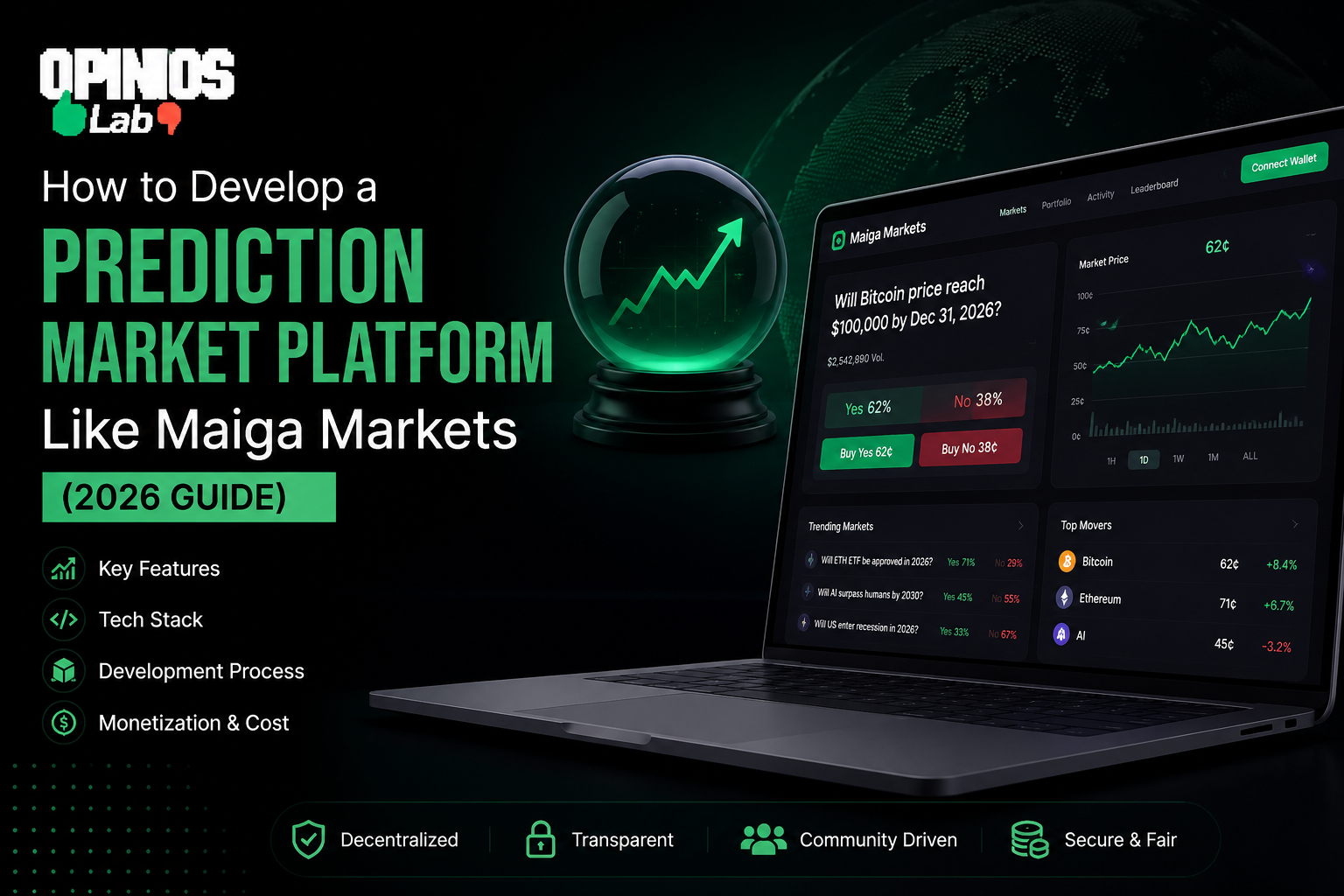
A prediction market platform is an online marketplace where users trade contracts based on the probability of future events. Contract prices represent the collective expectations of participants, making prediction markets useful for forecasting politics, finance, sports, cryptocurrency, technology, and many other real world events.



20th July 2026
Prediction markets have evolved from a niche financial experiment into one of the fastest-growing sectors in blockchain and fintech. In March 2026, the industry processed approximately $25.7 billion in monthly trading volume, representing a 10.6% month-over-month increase. Analysts now estimate that annual prediction market volume could range anywhere between $240 billion and $1.3 trillion by the end of 2026, highlighting just how rapidly this asset class is expanding. These figures demonstrate that prediction markets are no longer experimental products—they are becoming mainstream financial platforms with global participation.
The explosive growth of platforms like Polymarket and Kalshi has proven that people are willing to trade on the probability of real-world events instead of relying solely on traditional investments or sports betting. Together, these two platforms account for roughly 85–90% of today’s prediction market volume, creating a highly competitive landscape. Yet this dominance has also opened the door for regional platforms such as Maiga Markets, which are differentiating themselves by focusing on underserved markets, localized event categories, and blockchain ecosystems like BNB Chain.
For entrepreneurs, startups, and Web3 businesses, this presents an exciting opportunity. Instead of competing directly with global giants, new entrants can build specialized platforms targeting specific industries, geographic regions, or niche prediction categories.
However, developing a prediction market platform is far more complex than creating a standard betting application. Success depends on several critical factors, including blockchain architecture, liquidity mechanisms, oracle infrastructure, regulatory compliance, user experience, and security.
In this comprehensive guide, you’ll learn:
- What a prediction market platform is
- How prediction markets function
- Why the industry is growing so quickly
- The technologies required to build one
- Development costs
- Legal considerations in 2026
- A practical roadmap inspired by Maiga Markets
Whether you’re planning to launch a decentralized prediction market or a regulated event-contract exchange, this guide will help you understand the technical and business fundamentals needed to succeed.
Why Businesses Are Investing in Prediction Market Platforms
With the prediction market industry experiencing exponential growth, businesses are increasingly looking to launch platforms that cater to specific industries, regions, or user communities. Rather than building from scratch, many startups work with a prediction market development company that has experience developing blockchain based trading platforms, decentralized applications, and smart contract ecosystems.
Companies such as Opinios Lab specialize in end to end prediction market development, helping businesses build scalable platforms with custom smart contracts, oracle integrations, liquidity mechanisms, compliance features, and intuitive trading experiences. Whether you plan to build a platform inspired by Polymarket or Kalshi, working with an experienced development partner can significantly reduce development time and technical risks.
What Is a Prediction Market Platform?
A prediction market platform is a digital marketplace where users trade contracts based on the likelihood of future events. Rather than betting against a bookmaker, participants buy and sell contracts whose prices reflect the market’s collective estimate of an event’s probability.
For example, imagine a market asking:
“Will Bitcoin exceed $150,000 before December 31, 2026?”
If “Yes” shares trade at $0.72, the market is effectively pricing a 72% probability that the event will occur. Conversely, “No” shares trading at $0.28 imply a 28% chance that Bitcoin will remain below the target price.
Once the event concludes, the contract settles:
- Yes shares pay $1 if the prediction is correct.
- No shares become worthless.
- If the prediction fails, the payout is reversed.
This pricing model allows prediction markets to aggregate collective intelligence from thousands—or even millions—of participants, making them valuable tools not only for speculation but also for forecasting elections, economic indicators, financial markets, technology trends, weather events, and even scientific discoveries.
A Brief History of Prediction Markets
Modern prediction markets trace their origins to 1988, when researchers at the University of Iowa launched the Iowa Electronic Markets. The project demonstrated that market-based forecasts often outperformed traditional polling methods in predicting election outcomes.
For decades, prediction markets remained relatively small due to regulatory uncertainty and limited accessibility. Their mainstream breakthrough came during the 2024 U.S. presidential election, when platforms like Kalshi and Polymarket collectively processed more than $4.5 billion in election-related contracts. This unprecedented activity introduced millions of users to event trading and proved that prediction markets could scale to handle significant global demand.
Prediction Markets vs. Sports Betting
At first glance, prediction markets resemble sportsbooks because both involve forecasting future outcomes. However, they differ fundamentally in structure and regulation.
Traditional sportsbooks set odds and act as the counterparty to wagers, generating revenue through margins and risk management. Prediction markets, on the other hand, allow participants to trade directly with one another or through automated market-making mechanisms. Prices fluctuate dynamically based on supply and demand, reflecting collective market sentiment rather than fixed bookmaker odds.
This distinction also affects regulation. Sports betting is typically governed by state gaming authorities, while prediction markets—particularly those involving financial or economic events—may fall under derivatives regulations enforced by agencies such as the U.S. Commodity Futures Trading Commission (CFTC). Understanding this legal distinction is essential for anyone planning to build or operate a prediction market platform.
How Do Prediction Markets Work?
Although prediction markets appear simple on the surface, they rely on sophisticated financial and blockchain infrastructure to ensure accurate pricing, transparent settlement, and trustless execution.
A typical prediction market follows a straightforward lifecycle.
1. A Market Is Created
The platform launches a contract tied to a future event, such as:
- Will Ethereum reach $10,000 in 2026?
- Will a specific political candidate win an election?
- Will global inflation fall below a target level?
- Will a sports team win a championship?
Each contract clearly defines its resolution criteria and settlement date to eliminate ambiguity.
2. Users Buy “Yes” or “No” Shares
Participants purchase shares representing either outcome.
Unlike traditional betting, these shares fluctuate in price throughout the contract’s lifespan. As new information emerges, market participants continuously reassess probabilities, causing prices to rise or fall.
For example:
- Yes = $0.40
- No = $0.60
The market currently estimates a 40% probability that the event will occur.
3. Pricing Adjusts in Real Time
Prediction markets generally use one of two pricing models:
- Automated Market Makers (AMMs): Smart contracts algorithmically adjust prices based on liquidity and trading activity. This model is common in decentralized platforms because it ensures continuous liquidity without relying on centralized intermediaries.
- Central Limit Order Books (CLOBs): Buyers and sellers submit bids and offers that are matched directly, similar to traditional stock exchanges. This approach provides tighter spreads and greater price precision but requires sufficient market liquidity.
Choosing between these models is one of the most important architectural decisions when developing a prediction market platform.
4. The Event Is Resolved
Once the event concludes, a trusted oracle or designated resolution mechanism verifies the outcome using predefined data sources. Accurate resolution is critical because it determines payouts and maintains confidence in the platform.
5. Winning Traders Receive Payouts
Correct positions settle at $1 per share, while losing positions expire worthless. On blockchain-based platforms, this settlement can occur automatically through smart contracts, ensuring transparency and eliminating the need for manual intervention.
Interestingly, today’s prediction markets are overwhelmingly driven by retail users rather than institutional traders. According to industry data, 82.3% of users trade less than $10,000 per quarter, while the median trade size ranges between just $2 and $3. This highlights that success in prediction markets depends on attracting broad community participation rather than a small number of high-volume traders.
Prediction Market Industry Statistics 2026
The prediction market industry has entered a new phase of growth. What was once considered a niche segment of decentralized finance has become one of the fastest expanding sectors in blockchain, fintech, and online trading. Strong user adoption, increasing regulatory clarity in several jurisdictions, and growing institutional interest have accelerated market activity at a remarkable pace.
For entrepreneurs looking to develop a prediction market platform like Maiga Markets, understanding the industry’s growth is essential. These numbers provide valuable insights into user behavior, market potential, and the opportunities that still exist for new entrants.
Prediction Market Industry Statistics at a Glance
| Metric | Figure | Source |
| Monthly trading volume, March 2026 | $25.7 billion with 10.6% month over month growth | CoinMarketCap and Bitget Wallet |
| Monthly trading volume, April 2026 | Approximately $24 billion | Pew Research Center |
| Active users | More than 800,000 wallets by January 2026 | Casino.org |
| Contracts traded each month | More than 8,000 by May 2026 | Ropes and Gray, CFTC |
| Estimated annual trading volume | $240 billion to $1.3 trillion | FXStreet and Gambling Insider |
| Market share | Polymarket and Kalshi account for approximately 85 to 90 percent | Gambling Insider and Business of iGaming |
| Wallet profitability | Around 58 percent of Polymarket wallets recorded net losses | Business of iGaming |
| Sports prediction market potential | Estimated $100 billion annually in the near term with long term projections reaching $1.1 trillion | Casino.org |
| User retention insight | Medium activity users trade across 2.3 categories compared to 1.45 categories for occasional users | FXStreet and Bitget Wallet |
Monthly Trading Volume Has Reached Historic Levels
One of the strongest indicators of industry growth is the surge in trading volume. In March 2026, prediction markets processed $25.7 billion in monthly volume, representing a 10.6 percent increase compared to the previous month. Just a few years ago, these figures would have seemed unrealistic.
Even more impressive is the pace of this growth. According to Pew Research Center, combined monthly trading volume on leading platforms reached nearly $24 billion in April 2026. In comparison, monthly volume remained below $5 billion during September 2025. This rapid expansion demonstrates how quickly prediction markets have moved into the mainstream financial ecosystem.
Several factors have contributed to this growth. The widespread adoption of blockchain technology has made decentralized trading more accessible. Stablecoins have simplified cross border transactions, while growing interest in political, financial, sports, and cryptocurrency events has created a constant stream of high demand markets.
User Growth Shows Strong Long Term Adoption
Trading volume alone does not tell the complete story. The number of active participants has increased just as dramatically.
In 2024, the industry had roughly 4,000 active monthly users. By late 2025, this figure had surpassed 600,000, and by January 2026, more than 800,000 blockchain wallets had participated in prediction markets.
This remarkable increase demonstrates that prediction markets are no longer limited to experienced crypto traders. Everyday users are now participating in event based trading because modern platforms offer simpler interfaces, faster onboarding, and more intuitive trading experiences.
For developers, this trend emphasizes the importance of user experience. A platform with an intuitive interface, clear market categories, and fast transaction processing is far more likely to attract and retain new users.
Retail Traders Continue to Drive the Market
A common misconception is that prediction markets are dominated by large investors. Current industry data tells a different story.
More than 82 percent of users trade less than $10,000 per quarter, while the median trade size ranges between only $2 and $3. These numbers indicate that prediction markets have become highly accessible to retail participants.
This has important implications for platform development. Rather than focusing exclusively on professional traders, successful platforms prioritize ease of use, educational content, transparent pricing, and low transaction costs. These features encourage broader participation and create healthier trading ecosystems.
Market Leadership Does Not Eliminate Opportunities
At present, Polymarket and Kalshi dominate the prediction market landscape, controlling an estimated 85 to 90 percent of overall market activity.
While this may appear intimidating for new entrants, it actually highlights an important market dynamic. These platforms primarily serve global audiences with broad event categories. Numerous regional and specialized markets remain underserved.
This is where Maiga Markets presents an interesting business model. Rather than competing directly on global liquidity, the platform focuses on Southeast Asia and emerging markets while leveraging the speed and lower transaction costs of BNB Chain. This strategy allows it to serve audiences whose interests and regional events may receive limited attention on larger platforms.
For startups, the lesson is clear. Competing with industry leaders does not necessarily require matching their scale. Building a platform around specific industries, geographic regions, or niche event categories can create a strong competitive advantage.
User Engagement Depends on Market Diversity
Another interesting finding from recent industry research concerns user retention.
Many assume that encouraging larger trades leads to better engagement. However, the data suggests otherwise.
Users who actively trade across multiple categories average participation in approximately 2.3 different market segments, while occasional users typically engage with only 1.45 categories.
This indicates that the breadth of available markets plays a more important role in retention than individual trade size.
For example, a user who trades cryptocurrency markets today may return tomorrow to participate in sports, elections, artificial intelligence, or entertainment related prediction markets. Expanding category diversity encourages repeat visits and increases overall platform activity.
Developers should therefore think beyond simply adding more liquidity. Creating a broad selection of relevant, well managed markets can significantly improve long term user engagement.
What These Statistics Mean for Entrepreneurs
The latest industry data paints a clear picture. Prediction markets are experiencing sustained growth rather than a temporary surge in popularity. Trading volumes continue to rise, user adoption is accelerating, and new market categories are attracting increasingly diverse audiences.
For entrepreneurs planning to build a platform like Maiga Markets, the opportunity lies in specialization rather than imitation. Instead of attempting to compete head to head with established platforms, founders can focus on regional communities, unique event categories, improved user experiences, and stronger compliance frameworks.
As the industry continues to mature, technology alone will no longer be enough to differentiate a platform. Success will depend on trust, regulatory readiness, liquidity management, and a clear understanding of the audience being served.
Is It Legal to Build a Prediction Market Platform in 2026?
One of the biggest challenges in developing a prediction market platform is not the technology. It is understanding the legal framework that governs event based trading.
Unlike traditional blockchain applications, prediction markets sit at the intersection of financial regulation, gaming law, securities law, and consumer protection. The answer to whether a platform is legal depends on several factors, including the jurisdiction in which it operates, the types of contracts it offers, how trades are settled, and whether it serves users in regulated markets such as the United States.
For founders inspired by platforms like Maiga Markets, legal planning should begin long before any smart contracts are deployed. A compliance first approach not only reduces regulatory risk but also builds trust among users, investors, and institutional partners.
Why Are Prediction Markets Legally Complex?
Prediction markets allow users to trade contracts tied to future events, but regulators often disagree on how these contracts should be classified.
Some authorities consider them financial derivatives because traders are buying and selling contracts whose value changes based on future outcomes. Others view them as a form of gambling because participants risk money on uncertain events.
This distinction is significant because financial derivatives and gambling activities are regulated under entirely different legal frameworks.
In the United States, many event contracts fall under the oversight of the Commodity Futures Trading Commission (CFTC), while gambling activities are generally regulated at the state level. As a result, prediction market operators must navigate overlapping regulations that can vary considerably from one jurisdiction to another.
How the Regulatory Landscape Changed in 2026
The regulatory environment evolved rapidly during 2026, making it one of the most important years in the history of prediction markets.
2024
The CFTC proposed classifying many political and sports related event contracts as gaming activities. Had this proposal been finalized, it would have significantly limited the types of markets that regulated platforms could offer.
However, the proposal was never formally adopted, largely because of ongoing legal challenges involving Kalshi and broader debates about the role of event contracts in financial markets.
February 2026
Following litigation involving Kalshi, the CFTC withdrew its earlier proposal.
This decision signaled a more measured approach toward regulating prediction markets and opened the door for a broader public discussion about how event contracts should be treated under existing commodities law.
Rather than imposing immediate restrictions, regulators shifted their focus toward gathering industry feedback and refining the regulatory framework.
March 2026
On March 12, 2026, the CFTC issued a Prediction Markets Advisory and simultaneously opened an Advance Notice of Proposed Rulemaking, commonly referred to as an ANPRM.
The objective was to collect public comments on how prediction market contracts should be evaluated and supervised in the future.
The consultation period remained open until April 30, 2026, allowing exchanges, legal experts, technology companies, academics, and market participants to submit recommendations.
June 2026
The most significant development occurred on June 10, 2026, when the CFTC published a formal Notice of Proposed Rulemaking that suggested amendments to Rule 40.11.
Among the proposed changes was a three step public interest test that regulators could use when determining whether specific event contracts should be permitted.
Public comments on these proposed rules were scheduled through July 27, 2026, illustrating that the regulatory framework continues to evolve.
For entrepreneurs, this means regulatory compliance cannot be treated as a one time exercise. Legal requirements may continue changing as governments gain more experience with prediction markets.
The Market Has Become Too Large to Ignore
Government attention is closely tied to the industry’s remarkable growth.
According to Greenberg Traurig, total trading volume across CFTC designated contract markets exceeded $25 billion during 2025 alone.
When an industry reaches this level of economic activity, regulators naturally increase oversight to address market integrity, consumer protection, and systemic risk.
As prediction markets continue expanding into areas such as sports, economics, artificial intelligence, and global politics, additional regulatory guidance should be expected over the coming years.
State Regulations Continue to Vary
Federal oversight is only part of the legal picture.
Individual states have also taken their own positions regarding prediction market platforms.
As of 2026, Arizona, Arkansas, Illinois, Louisiana, Massachusetts, Maryland, Michigan, Nevada, and Ohio have introduced restrictions, enforcement actions, or limitations affecting certain prediction market applications.
For companies operating in the United States, this creates additional compliance obligations because a platform may be permitted at the federal level while still facing restrictions in specific states.
Many operators address this challenge through geofencing technology, which prevents users in restricted jurisdictions from accessing regulated markets.
What About Platforms Outside the United States?
This is where platforms like Maiga Markets demonstrate a different strategic approach.
Rather than focusing exclusively on the United States, Maiga Markets targets Southeast Asia and other emerging markets.
Operating outside U.S. jurisdiction may reduce exposure to CFTC oversight, but it does not eliminate legal responsibilities.
Every country has its own financial regulations, virtual asset service provider requirements, anti money laundering obligations, and consumer protection laws.
Founders should therefore review local licensing requirements before launching operations in any jurisdiction.
For example, some countries classify crypto based prediction markets as digital asset services, while others regulate them under gaming legislation or financial market laws.
Understanding these differences before launch can prevent expensive legal disputes later.
Compliance Should Be Built Into the Platform
Many startups treat compliance as something to address after building the product.
That approach no longer works.
Modern prediction market platforms should incorporate compliance directly into their technical architecture from the beginning.
This includes features such as:
- Identity verification for regulated users
- Anti money laundering monitoring
- Geographic access restrictions
- Transaction monitoring
- Market surveillance
- Insider trading detection
- Audit trails
- Secure record keeping
Building these capabilities early is often less expensive than retrofitting them after launch.
It also makes the platform more attractive to institutional investors, enterprise partners, and regulators.
Legal Advice Is Essential
Every prediction market platform operates under unique circumstances.
The markets you offer, the countries you target, the blockchain you choose, and the custody model you implement all influence your legal obligations.
For that reason, this article should be viewed as general educational information rather than legal advice.
Before launching a prediction market platform, consult qualified legal professionals with expertise in financial regulation, blockchain technology, digital assets, and international compliance.
Taking the time to establish a legally compliant foundation can save significant costs, protect your business from enforcement actions, and create a stronger platform for long term growth.
Tech Stack and Development Cost of a Prediction Market Platform
Building a prediction market platform requires much more than deploying a few smart contracts on a blockchain. A successful platform combines decentralized infrastructure, secure backend services, intuitive user interfaces, real time data processing, and compliance systems into one seamless ecosystem.
Many startups also prefer accelerating development by using a Polymarket clone script as a foundation instead of building every component from scratch. A production ready clone can include core trading functionality, wallet integration, market creation, oracle support, and liquidity management, allowing businesses to focus on branding, customization, and regulatory compliance rather than rebuilding proven infrastructure.
Platforms like Polymarket, Kalshi, and the upcoming Maiga Markets all rely on carefully designed architectures that prioritize trust, speed, transparency, and scalability. Every component of the technology stack plays a role in creating a reliable trading experience.
Below is a breakdown of the essential technologies needed to build a modern prediction market platform.
1. Market Engine
The market engine is the heart of every prediction market. It determines how prices are calculated, how trades are executed, and how liquidity is maintained.
Developers generally choose between two primary market models.
Automated Market Maker
An Automated Market Maker, often referred to as an AMM, uses mathematical formulas to determine contract prices automatically.
Instead of waiting for buyers and sellers to match orders, traders interact directly with liquidity pools.
Advantages include:
- Continuous liquidity
- Simple user experience
- Lower operational complexity
- Ideal for decentralized platforms
Many Web3 prediction markets prefer AMMs because they eliminate the need for traditional market makers.
Central Limit Order Book
A Central Limit Order Book matches buyers and sellers directly.
This model resembles traditional stock exchanges where users place bids and asks that are matched according to price and time.
Advantages include:
- Better price discovery
- Lower spreads
- Greater efficiency in high volume markets
- Preferred by professional traders
However, order books require significantly higher liquidity to function effectively.
Which Model Does Maiga Markets Use?
While Maiga Markets is built on BNB Chain, its long term architecture emphasizes blockchain efficiency and decentralized trading experiences similar to modern DeFi applications. The choice of blockchain also allows faster confirmations and lower transaction costs compared with many competing networks.
2. Oracle and Resolution Layer
The oracle system is arguably the most important component of any prediction market.
Every contract eventually reaches an outcome.
Someone or something must determine whether that outcome actually occurred.
This responsibility belongs to the oracle layer.
Without reliable oracles, users cannot trust payouts, making the platform unusable regardless of how good the interface looks.
Developers typically choose one of two approaches.
Decentralized Oracles
Decentralized oracle networks obtain information from multiple independent sources before reaching consensus.
Benefits include:
- Higher transparency
- Reduced manipulation risk
- Greater community trust
- Suitable for decentralized ecosystems
Centralized Resolution
Some platforms rely on internal administrators or trusted organizations to resolve markets.
Benefits include:
- Faster decisions
- Simpler implementation
- Easier handling of ambiguous events
The downside is reduced decentralization, which may discourage crypto native users.
When designing a prediction market platform, the oracle should be planned before almost every other feature because it forms the foundation of user trust.
3. Frontend Development
The frontend determines how users experience the platform.
Prediction markets generate continuous price updates, making performance and responsiveness critical.
Essential frontend features include:
- Real time market prices
- Live probability updates
- Portfolio dashboard
- Market search
- Trading charts
- Category filters
- Mobile responsive interface
- Dark mode support
- Wallet connection
Most decentralized platforms integrate wallets such as MetaMask or WalletConnect, allowing users to trade directly from their crypto wallets.
Businesses targeting mainstream audiences may also provide custodial accounts where users register using email and passwords before funding their accounts.
A clean interface often becomes a competitive advantage because many blockchain applications still overwhelm new users with unnecessary complexity.
4. Backend Infrastructure
Although blockchain handles settlement, substantial backend infrastructure is still required.
Typical backend services include:
- User authentication
- API management
- Market creation tools
- Notification services
- Analytics dashboards
- Trading history
- Leaderboards
- Administrative controls
- Database management
- Event indexing
Many blockchain platforms also implement indexing services similar to The Graph to retrieve blockchain data efficiently.
Without indexing, displaying historical trades, portfolio balances, and market statistics becomes slow and resource intensive.
Scalability should also be considered from the beginning.
As trading volume increases from hundreds to millions of transactions, backend optimization becomes increasingly important.
5. Compliance and Security Layer
Modern prediction markets cannot ignore compliance.
As regulatory oversight continues expanding worldwide, compliance systems have become core infrastructure rather than optional features.
Essential compliance capabilities include:
- Identity verification
- Anti money laundering monitoring
- Geographic restrictions
- Transaction monitoring
- Fraud detection
- Insider trading surveillance
- Risk scoring
- Audit logging
This shift is reflected across the industry.
During 2026, Polymarket significantly strengthened its governance framework to address concerns related to market manipulation and insider trading, demonstrating that compliance is now considered a competitive advantage rather than simply a regulatory requirement.
Businesses that invest in compliance from day one often gain greater credibility with regulators, investors, and institutional partners.
How Much Does It Cost to Develop a Prediction Market Platform?
Development costs vary depending on project complexity, blockchain selection, security requirements, and regulatory obligations.
An MVP designed to validate a business idea requires a much smaller investment than a fully decentralized multi chain ecosystem with institutional grade security.
Below is a general cost estimate based on current blockchain development benchmarks.
| Build Tier | Scope | Estimated Cost |
| MVP | Basic AMM, single blockchain, essential trading features | $20,000 to $50,000 |
| Custom Platform | Smart contracts, oracle integration, compliance features, advanced UI | $60,000 to $150,000 |
| Enterprise Grade Platform | Multi chain infrastructure, advanced security, institutional features | $200,000 to $550,000 or more |
| Blockchain prediction or betting application | Wallet integration, smart contracts, crypto payments | $50,000 to $100,000 or more |
These estimates vary depending on development region, project scope, and security requirements.
Where Does the Budget Go?
Many founders underestimate how development budgets are distributed.
In reality, software coding represents only one part of the overall investment.
A typical project budget includes:
| Component | Approximate Share |
| Software development | 40 to 60 percent |
| Security audits | 15 to 20 percent |
| UI and UX design | 10 to 15 percent |
| Infrastructure | 5 to 10 percent |
| Testing and quality assurance | 10 to 15 percent |
Security audits deserve particular attention.
Basic smart contract audits may cost around $5,000, while comprehensive audits for complex decentralized finance protocols can exceed $500,000, depending on the platform’s architecture and risk profile.
Ongoing Operating Costs
Launching the platform is only the beginning.
Successful prediction markets require continuous maintenance and operational support.
Typical recurring expenses include:
- Cloud infrastructure
- Blockchain nodes
- Oracle services
- Customer support
- Security monitoring
- Compliance updates
- Software maintenance
- Smart contract upgrades
- Marketing
- Liquidity incentives
Industry benchmarks suggest infrastructure costs generally range between $100 and $800 per month, while ongoing blockchain application maintenance typically falls between $3,000 and $8,000 per month, depending on platform size and traffic.
These recurring investments ensure the platform remains secure, compliant, and capable of handling increasing trading activity as the user base grows.
Building a successful prediction market platform involves much more than choosing a blockchain or writing smart contracts. Every stage, from market research to post launch monitoring, contributes to the platform’s long term success. Entrepreneurs who approach development strategically are far more likely to build a product that attracts users, satisfies regulators, and scales sustainably.
Below is a practical roadmap inspired by successful prediction market platforms and the regional strategy adopted by Maiga Markets.
Step 1: Define Your Niche and Target Market
The prediction market industry has become increasingly competitive, making it difficult for new platforms to succeed by copying existing leaders.
Before writing any code, identify your target audience and define what makes your platform different.
Consider questions such as:
- Which geographic markets will you serve?
- Which event categories will receive the most attention?
- Will you target crypto native users, mainstream consumers, or institutional traders?
- What regulatory framework applies to your target market?
Maiga Markets provides an excellent example of strategic positioning. Instead of competing directly for the same global audience as Polymarket and Kalshi, it focuses on Southeast Asia and other emerging markets where demand continues to grow and localized event categories remain underserved.
Step 2: Choose Your Platform Model
Prediction markets generally follow one of three operating models.
A fully decentralized platform uses smart contracts for market creation, trading, and settlement, giving users complete control over their assets.
A custodial platform manages user funds internally, offering a simpler experience for newcomers while taking responsibility for compliance and asset security.
A hybrid model combines decentralized settlement with centralized account management and compliance features, offering a balance between usability and transparency.
Your choice affects technical architecture, legal obligations, and user experience.
Many entrepreneurs evaluating the market also compare Kalshi like clone software with fully custom development. While clone software provides a faster route to market by replicating core functionality, custom development offers greater flexibility for introducing new market categories, blockchain integrations, governance models, and regional compliance features. The right approach depends on your business goals, launch timeline, and scalability requirements.
Step 3: Select the Right Blockchain
Blockchain selection influences nearly every aspect of the platform.
Important considerations include:
- Transaction fees
- Network speed
- Smart contract ecosystem
- Wallet compatibility
- Community adoption
- Developer tools
- Security
Many prediction markets have traditionally favored Polygon because of its scalability and low transaction costs.
Maiga Markets, however, has chosen BNB Chain, which provides fast confirmations, lower fees, and access to a large blockchain ecosystem. This choice reflects its focus on making prediction markets accessible to users in rapidly growing digital economies.
Step 4: Design the Oracle Before Building Anything Else
Many founders prioritize interface design or trading features first.
This is often a mistake.
The oracle determines how every market is resolved. If users cannot trust the outcome verification process, they will not trust the platform.
When designing the oracle system, define:
- Approved data sources
- Dispute resolution procedures
- Timeframes for settlement
- Backup verification methods
- Governance rules
Investing time in oracle design early reduces future disputes and improves platform credibility.
Step 5: Build Compliance Into the Product
Regulatory compliance should never be treated as an afterthought.
Modern prediction market platforms should incorporate:
- Identity verification
- Anti money laundering procedures
- Geographic restrictions
- Transaction monitoring
- Risk management
- Audit logging
Embedding these systems during development is significantly easier than attempting to integrate them after launch.
Step 6: Develop the Trading Engine
Once the foundation is established, development can focus on the platform’s trading infrastructure.
Core components include:
- Smart contracts
- Liquidity mechanisms
- Market creation tools
- Portfolio management
- Real time pricing
- Settlement automation
- Analytics
Every component should undergo rigorous testing before deployment because even minor bugs can compromise financial integrity.
Step 7: Bootstrap Liquidity
No prediction market succeeds without liquidity.
Users expect competitive prices and the ability to enter or exit positions quickly.
Early stage platforms commonly encourage liquidity through:
- Trading competitions
- Liquidity mining
- Reduced trading fees
- Community incentive programs
- Referral campaigns
- Strategic partnerships
Building an active community is just as important as building the technology itself.
Step 8: Expand Gradually
Launching with hundreds of markets may appear attractive, but it often divides liquidity across too many contracts.
A better strategy is to begin with a carefully selected group of high demand markets before expanding into additional categories.
Industry research shows that users who participate across multiple categories are more likely to remain active over time. Rather than encouraging larger trades, expanding the variety of available markets has a greater impact on long term retention.
Step 9: Monitor Market Integrity
Prediction markets depend on trust.
Platforms should continuously monitor for:
- Market manipulation
- Wash trading
- Insider activity
- Suspicious trading behavior
- Oracle attacks
- Smart contract vulnerabilities
Regular security audits and transparent governance policies help maintain confidence among users and regulators alike.
Maiga Markets Case Study
As prediction markets become increasingly competitive, regional specialization is emerging as one of the strongest growth strategies.
Rather than attempting to outperform established leaders in every market category, Maiga Markets focuses on Southeast Asia and other emerging economies while leveraging the efficiency of BNB Chain.
This regional approach enables the platform to serve audiences whose interests may receive limited attention on larger global exchanges. It also benefits from lower blockchain transaction costs and a rapidly expanding Web3 ecosystem.
With Polymarket and Kalshi controlling approximately 85 to 90 percent of overall market volume, competing directly on liquidity would be extremely difficult for most startups. Maiga Markets demonstrates that focusing on underserved regions, localized prediction markets, and community driven growth can be a more practical strategy for long term success.
Conclusion
Prediction markets have evolved into one of the fastest growing segments of the digital economy. Billions of dollars in monthly trading volume, hundreds of thousands of active users, and increasing institutional attention demonstrate that this industry is moving well beyond its experimental beginnings.
However, building a successful prediction market platform requires much more than blockchain expertise. Developers must combine secure smart contracts, reliable oracle systems, intuitive user experiences, scalable infrastructure, strong liquidity strategies, and comprehensive compliance frameworks into a single ecosystem.
The success of platforms like Maiga Markets illustrates an important lesson for entrepreneurs. Competing with established industry leaders does not always require matching their global scale. Focusing on underserved regions, specialized markets, and superior user experiences can create meaningful competitive advantages while positioning a platform for sustainable long term growth.
As regulatory frameworks continue to mature and blockchain technology becomes more accessible, prediction markets are expected to play an increasingly important role in finance, forecasting, and digital asset ecosystems.
Ready to Build a Prediction Market Platform Like Maiga Markets?
Launching a secure and scalable prediction market platform requires expertise in blockchain development, smart contracts, oracle integration, liquidity management, and regulatory compliance. As a leading prediction market development company, Opinios Lab helps startups, enterprises, and Web3 businesses transform innovative ideas into production ready platforms.
Whether you need a fully customized prediction marketplace, a Polymarket clone script, or Kalshi like clone software, our experienced blockchain developers deliver end to end development services tailored to your business requirements. From UI and UX design to smart contract development, security audits, wallet integration, and post launch support, we help you launch a future ready platform faster and with confidence.
Ready to build your own prediction market platform? Contact Opinios Lab today and bring your vision to life.
Frequently Asked Questions
What is a prediction market platform?
Is it legal to build a prediction market platform in the United States?
Yes, but legal compliance depends on the types of contracts offered and the jurisdictions served. Prediction markets may fall under CFTC oversight, while individual states may impose additional restrictions. Businesses should consult experienced legal professionals before launching operations in the United States.
How much does it cost to build a prediction market platform?
Development costs typically range from $20,000 for a basic MVP to more than $550,000 for an enterprise grade multi chain platform. Final costs depend on blockchain selection, security requirements, compliance features, oracle infrastructure, and overall project complexity.
Which blockchain is best for a prediction market platform?
There is no universal answer. Polygon remains popular because of its scalability, while BNB Chain offers lower fees and faster transactions. The ideal blockchain depends on your target audience, regulatory requirements, ecosystem compatibility, and long term business strategy.
How are prediction market contracts resolved?
Contracts are settled after the underlying event concludes. Resolution is usually handled through decentralized oracle networks or trusted verification mechanisms that determine the official outcome before smart contracts automatically distribute payouts.

Start Creating Your Own Prediction Platform


Disclaimer
As per the Online Gaming Bill, 2025 and applicable Indian laws, we strictly do not develop, provide, or promote any Real Money Games (RMG), Real Money Features, RMG Development Services, or Game with RMG Features. While our website may mention terms like “Real Money Game” or “RMG Features” for general informational and educational purpose.